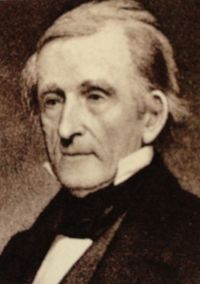
George Tucker

George Tucker

Summary

Portrait of George Tucker George Tucker A Voyage to the Moon

The whole face of the moon was of a silvery hue, relieved and varied by the softest and most delicate shades. No cloud nor speck of vapour intercepted my view. One of my exclamations of delight awakened the Brahmin, who quickly arose, and looking down on the resplendent orb below us, observed that we must soon begin to slacken the rapidity of our course, by throwing out ballast. The moon's dimensions now rapidly increased; the separate mountains, which formed the ridges and chains on her surface, began to be plainly visible through the telescope
Source: Gutenberg

Portrait of George Tucker George Tucker A Voyage to the Moon

Nothing, my dear Atterley, is more true than the saying of your wise book—that all flesh is grass; and it always takes the same quantity of one to make a given quantity of the other, whether that given quantity may be in the form of a single individual, or two or three. But in the former case, great labour is required to force nature beyond her ordinary limits, and the same labour must be unceasingly kept up, or she will certainly relapse to her original dimensions. This system may do, as our host here tells us it actually does, for the moon, but it is not suited to our earth.
Source: Gutenberg

Portrait of George Tucker George Tucker A Voyage to the Moon

I could not help meditating on the melancholy uncertainty of human life, when I contrasted the comforts, the pleasures, the pride of conscious usefulness and genius felt by this gentleman a short time since, with the agony which that trying and bitter hour brings to the stoutest and most callous heart—when it must quit this state of being for another, of which it knows so little, and over which fear and doubt throw a gloom that hope cannot entirely dispel.
Source: Gutenberg

Get perspective with Kwize: daily news enlightened by great literature