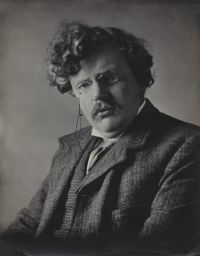
Gilbert Keith Chesterton

Gilbert Keith Chesterton

Summary

Portrait of Gilbert Keith Chesterton Gilbert Keith Chesterton Eugenics and other Evils — Part I, Chapter I (1922)

People talk about the impatience of the populace; but sound historians know that most tyrannies have been possible because men moved too late. It is often essential to resist a tyranny before it exists. It is no answer to say, with a distant optimism, that the scheme is only in the air. A blow from a hatchet can only be parried while it is in the air.
There exists to-day a scheme of action, a school of thought, as collective and unmistakable as any of those by whose grouping alone we can make any outline of history.
Source: Wikisource

Portrait of Gilbert Keith Chesterton Gilbert Keith Chesterton Eugenics and other Evils — Part I, Chapter I (1922)

But there really cannot be any Eugenist quite so dull as not to see that this is not a defence of Eugenics but a direct denial of Eugenics. If something which has been discovered at last by the lamp of learning is something which has been acted on from the first by the light of nature, this (so far as it goes) is plainly not an argument for pestering people, but an argument for letting them alone. If men did not marry their grandmothers when it was, for all they knew, a most hygienic habit
Source: Wikisource

Portrait of Gilbert Keith Chesterton Gilbert Keith Chesterton Eugenics and other Evils — Part I, Chapter I (1922)

Briefly, we may say that while many moral systems have set restraints on sex almost as severe as any Eugenist could set, they have almost always had the character of securing the fidelity of the two sexes to each other, and leaving the rest to God. To introduce an ethic which makes that fidelity or infidelity vary with some calculation about heredity is that rarest of all things, a revolution that has not happened before.
Source: Wikisource

Get perspective with Kwize: daily news enlightened by great literature