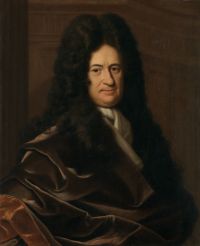
Gottfried Leibniz

Gottfried Leibniz

Monadology (1867)

Summary

Portrait of Gottfried Leibniz Gottfried Leibniz Monadology (1867)

If we imagine a machine so constructed as to produce thought, sensation, perception, we may conceive it magnified—the same proportions being preserved—to such an extent that one might enter it like a mill. This being supposed, we should find in it on inspection only pieces which impel each other, but nothing which can explain a perception. It is in the simple substance, therefore—not in the compound, or in machinery—that we must look for that phenomenon; and in the simple substance we find nothing else—nothing, that is, but perceptions and their changes.
Source: Wikisource

Portrait of Gottfried Leibniz Gottfried Leibniz Monadology (1890)

But there must also be a sufficient reason for contingent truths, or those of fact,—that is, for the series of things diffused through the universe of created objects—where the resolution into particular reasons might run into a detail without limits, on account of the immense variety of objects and the division of bodies ad infinitum. There is an infinity of figures and of movements, present and past, which enter into the efficient cause of my present writing, and there is an infinity of trifling inclinations and dispositions, past and present, of my soul, which enter into the final cause.
Source: Wikisource

Portrait of Gottfried Leibniz Gottfried Leibniz Monadology (1890)

If we choose to give the name soul to everything that has perceptions and desires in the general sense which I have just explained, all simple substances or created monads may be called souls, but as feeling is something more than a simple perception, I consent that the general name of monads or entelechies shall suffice for those simple substances which have only perception, and that only those substances shall be called souls whose perception is more distinct and is accompanied by memory.
Source: Wikisource

Get perspective with Kwize: daily news enlightened by great literature