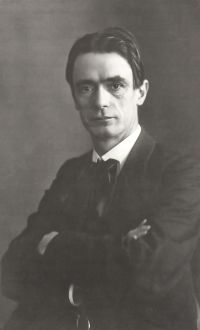
Rudolf Steiner

Rudolf Steiner

Summary

Portrait of Rudolf Steiner Rudolf Steiner,  Christianity As Mystical Fact… (1914)

“ He who only follows what his body ordains is not moral. Who is valiant? asks Socrates. He is valiant who does not obey his body but the demands of his spirit when these demands imperil the body. And who is temperate? Is not this he who "does not let himself be carried away by desires, but who maintains an indifferent and moral demeanour with regard to them. Therefore are not those alone temperate who set least value on the body and live in the love of wisdom?" And so it is, in the opinion of Socrates, with all virtues. ”
Source: Wikisource

Portrait of Rudolf Steiner Rudolf Steiner,  Christianity As Mystical Fact… (1914)

“ The dying Socrates does not prove the immortality of the soul, he simply lays bare the nature of the soul. And then it comes to light that growth and decay, birth and death, have nothing to do with the soul. The essence of the soul lies in the true, and this can neither come into being nor perish. The soul has no more to do with the becoming than the straight has with the crooked. ”
Source: Wikisource

Portrait of Rudolf Steiner Rudolf Steiner,  Christianity As Mystical Fact… (1914)

“ Socrates thus expresses himself on this point: "But how is it with reasonable knowledge itself? Is the body a hindrance or not, if we take it as a companion in our search for knowledge? I mean, do sight and hearing procure man any truth? Or is what the poets sing meaningless, that we see and hear nothing clearly?... When does the soul catch sight of truth? For when it tries to examine something with the help of the body, it is manifestly deceived by the latter." ”
Source: Wikisource

Get perspective with Kwize: daily news enlightened by great literature