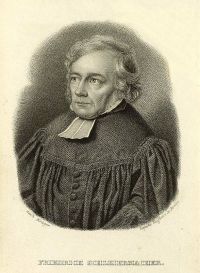
Friedrich Schleiermacher

Friedrich Schleiermacher

Summary

Portrait of Friedrich Schleiermacher Friedrich Schleiermacher Philological Museum vol 2 (1833)

This might have been not unfairly turned by a sophist against Socrates himself, if he had dragged in a notion apparently less familiar, in order to illustrate another ; and certainly this proposition, taken in a general sense, would not only have endangered the conduct of life, but would also have altogether destroyed the Socratic idea of science, that nothing can be known except together with the rest, and along with its relation to all things beside. The real case is simply this. It is clear that Socrates had no peculiar talent for any single science, and least of all for that of physics.
Source: Wikisource

Portrait of Friedrich Schleiermacher Friedrich Schleiermacher Philological Museum vol 2 (1833)

With Socrates most writers make a new period to begin in the history of Greek philosophy; which at all events manifestly implies that he breathed a new spirit and character into those intellectual exertions of his countrymen, which we comprehend under the name of philosophy, so that they assumed a new form under his hands, or at least that he materially widened their range. But if we inquire how the same writers describe Socrates as an individual, we find nothing that can serve as a foundation for the influence they assign to him.
Source: Wikisource

Portrait of Friedrich Schleiermacher Friedrich Schleiermacher Philological Museum vol 2 (1833)

For if in all that Plato has left we are to select only what is least speculative, least artificial, least poetical, and hence, for so we are taught, least enthusiastic, we shall indeed still retain much matter for this more refined and pregnant species of dialogues, to season Xenophon's tediousness, but it will be impossible in this way to discover any properly philosophical basis in the constitution of Socrates.
Source: Wikisource

Get perspective with Kwize: daily news enlightened by great literature