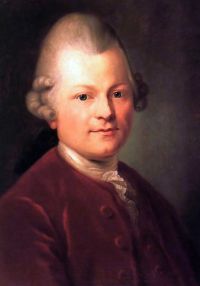
Gotthold Ephraim Lessing

Gotthold Ephraim Lessing

Laocoon (1873)

Summary

Portrait of Gotthold Ephraim Lessing Gotthold Ephraim Lessing,  Laocoon (1873)

“ Venus delivering to her son the armor of the gods is a subject equally suitable to artist and poet. For here she can be endowed with all the grace and beauty befitting the goddess of love. Such treatment will be of advantage as helping us the more easily to recognize her. But when Venus, intent on revenging herself on her contemners, the men of Lemnos, wild, in colossal shape, with cheeks inflamed and dishevelled hair, seizes the torch, and, wrapping a black robe about her, flies downward on the storm-cloud,—that is no moment for the painter, because he has no means of making us recognize her. ”
Source: Gutenberg

Portrait of Gotthold Ephraim Lessing Gotthold Ephraim Lessing,  Laocoon (1873)

“ The same advantage is possessed by the painter when his subject is so familiar to us that we take in at a glance the meaning and design of his whole composition, and can not only see that his characters are speaking, but can even hear what they say. On that first glance the chief effect depends. If that necessitate a tiresome guessing and pondering, our readiness to be touched is chilled. We take revenge upon the unwise artist by hardening ourselves against his expression; and alas for him, if to that expression he have sacrificed beauty! No inducement remains for us to linger before his work. ”
Source: Gutenberg

Portrait of Gotthold Ephraim Lessing Gotthold Ephraim Lessing,  Laocoon (1873)

“ Further, nothing obliges the poet to concentrate his picture into a single moment. He can take up every action, if he will, from its origin, and carry it through all possible changes to its issue. Every change, which would require from the painter a separate picture, costs him but a single touch; a touch, perhaps, which, taken by itself, might offend the imagination, but which, anticipated, as it has been, by what preceded, and softened and atoned for by what follows, loses its individual effect in the admirable result of the whole. ”
Source: Gutenberg

Get perspective with Kwize: daily news enlightened by great literature