Summary

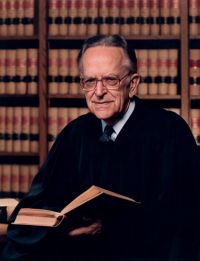
Portrait of Harry Blackmun Harry Blackmun Wyman v. James — Opinion of the Court

The State, working through its qualified welfare agency, has appropriate and paramount interest and concern in seeing and assuring that the intended and proper objects of that tax-produced assistance are the ones who benefit from the aid it dispenses. Surely it is not unreasonable, in the Fourth Amendment sense or in any other sense of that term, that the Stae have at its command a gentle means, of limited extent and of practical and considerate application, of achieving that assurance.
Source: Wikisource

Portrait of Harry Blackmun Harry Blackmun Wyman v. James — Opinion of the Court

In deciding that the homes of AFDC recipients are not entitled to protection from warrantless searches by welfare caseworkers, the Court declines to follow prior case law and employs a rationale that, if applied to the claims of all citizens, would threaten the vitality of the Fourth Amendment. This Court has occasionally pushed beyond established constitutional contours to protect the vulnerable and to further basic human values. I find no little irony in the fact that the burden of today's departure from principled adjudication is placed upon the lowly poor.
Source: Wikisource

Portrait of Harry Blackmun Harry Blackmun Wyman v. James — Opinion of the Court

One who dispenses purely private charity naturally has an interest in and expects to know how his charitable funds are utilized and put to work. The public, when it is the provider, rightly expects the same. It might well expect more, because of the trust aspect of public funds, and the recipient, as well as the caseworker, has not only an interest but an obligation.
4. The emphasis of the New York statutes and regulations is upon the home, upon 'close contact' with the beneficiary, upon restoring the aid recipient 'to a condition of self-support,' and upon the relief of his distress.
Source: Wikisource

Get perspective with Kwize: daily news enlightened by great literature