Summary

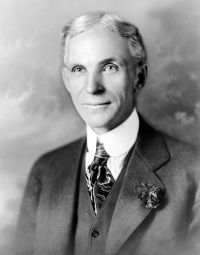
Portrait of Henry Ford Henry Ford My Life and Work — 11. Money and Goods (1922)

On the cost sheet, wages are mere figures; out in the world, wages are bread boxes and coal bins, babies' cradles and children's education--family comforts and contentment. On the other hand, there is something just as sacred about capital which is used to provide the means by which work can be made productive. Nobody is helped if our industries are sucked dry of their life-blood. There is something just as sacred about a shop that employs thousands of men as there is about a home.
Source: Wikisource

Portrait of Henry Ford Henry Ford My Life and Work — 11. Money and Goods (1922)

When a business becomes congested with bad methods; when a business becomes ill through lack of attention to one or more of its functions; when executives sit comfortably back in their chairs as if the plans they inaugurated are going to keep them going forever; when business becomes a mere plantation on which to live, and not a big work which one has to do--then you may expect trouble. You will wake up some fine morning and find yourself doing more business than you have ever done before--and getting less out of it. You find yourself short of money. You can borrow money.
Source: Wikisource

Portrait of Henry Ford Henry Ford My Life and Work — 11. Money and Goods (1922)

The minutes we spend in becoming expert in finance we lose in production. The place to finance a manufacturing business is the shop, and not the bank. I would not say that a man in business needs to know nothing at all about finance, but he is better off knowing too little than too much, for if he becomes too expert he will get into the way of thinking that he can borrow money instead of earning it and then he will borrow more money to pay back what he has borrowed, and instead of being a business man he will be a note juggler, trying to keep in the air a regular flock of bonds and notes.
Source: Wikisource

Get perspective with Kwize: daily news enlightened by great literature