Summary

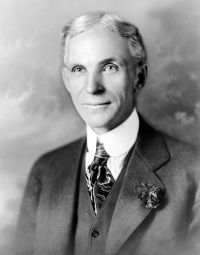
Portrait of Henry Ford Henry Ford My Life and Work — 19. What We May Expect (1922)

But if one has visions of service, if one has vast plans which no ordinary resources could possibly realize, if one has a life ambition to make the industrial desert bloom like the rose, and the work-a-day life suddenly blossom into fresh and enthusiastic human motives of higher character and efficiency, then one sees in large sums of money what the farmer sees in his seed corn--the beginning of new and richer harvests whose benefits can no more be selfishly confined than can the sun's rays.
Source: Wikisource

Portrait of Henry Ford Henry Ford My Life and Work — 19. What We May Expect (1922)

I intend to prove it with railways and public-service corporations--not for my personal satisfaction and not for the money that may be earned. (It is perfectly impossible, applying these principles, to avoid making a much larger profit than if profit were the main object.) I want to prove it so that all of us may have more, and that all of us may live better by increasing the service rendered by all businesses. Poverty cannot be abolished by formula; it can be abolished only by hard and intelligent work.
Source: Wikisource

Portrait of Henry Ford Henry Ford My Life and Work — 19. What We May Expect (1922)

The various wholly artificial rules set up for finance and industry and which pass as "laws" break down with such frequency as to prove that they are not even good guesses. The basis of all economic reasoning is the earth and its products. To make the yield of the earth, in all its forms, large enough and dependable enough to serve as the basis for real life--the life which is more than eating and sleeping--is the highest service. That is the real foundation for an economic system. We can make things--the problem of production has been solved brilliantly.
Source: Wikisource

Get perspective with Kwize: daily news enlightened by great literature