Summary

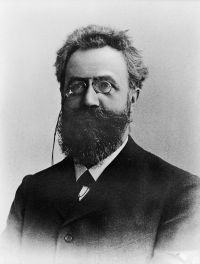
Portrait of Hermann Ebbinghaus Hermann Ebbinghaus Memory: A Contribution to Experimental Psychology… (1913)

The deviation which is greatest absolutely is toward the lower limit.
If several of our series of syllables were combined into groups and then memorised separately, the length of time necessary to memorise a whole group varied greatly, to be sure, when repeated tests were taken; but, in spite of this, when taken as a whole they varied in a manner similar to that of the measures of the ideally homogeneous processes of natural science, which also vary from each other.
Source: Wikisource

Portrait of Hermann Ebbinghaus Hermann Ebbinghaus Memory: A Contribution to Experimental Psychology… (1913)

So, at least in experimental fashion, it is allowable to use the mean values obtained from the numerical results for the various tests in order to establish the existence of causal relations just as natural science does that by means of its constants.
The number of series of syllables which is to be combined into a single group, or test, is naturally indeterminate. It must be expected, however, that as the number increases, the correspondence between the distribution of the times actually found and those calculated in accordance with the law of errors will be greater.
Source: Wikisource

Portrait of Hermann Ebbinghaus Hermann Ebbinghaus Memory: A Contribution to Experimental Psychology… (1913)

The symmetry of the distribution leaves something to be desired. The values below the average preponderate a little in number, those above preponderate a little in amount of deviation: only two of the largest eight deviations are below the mean value. The influence of attention referred to above, the fluctuations of which in the separate series show greater deviations toward the upper limit than toward the lower, has not, therefore, been quite compensated by the combination of several series.
Source: Wikisource

Get perspective with Kwize: daily news enlightened by great literature