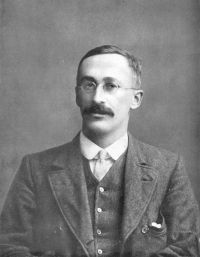
William Sealy Gosset

William Sealy Gosset

Summary

Portrait of William Sealy Gosset William Sealy Gosset The Probable Error of a Mean (1908)

If the number of experiments be very large, we may have precise information as to the value of the mean, but if our sample be small, we have two sources of uncertainty:— (1) owing to the “error of random sampling” the mean of our series of experiments deviates more or less widely from the mean of the population, and (2) the sample is not sufficiently large to determine what is the law of distribution of individuals.
Source: Wikisource

Portrait of William Sealy Gosset William Sealy Gosset The Probable Error of a Mean (1908)

We see then that if the distribution is approximately normal our theory gives us a satisfactory measure of the certainty to be derived from a small sample in both the cases we have tested; but we have an indication that a fine grouping is of advantage. If the distribution is not normal, the mean and the standard deviation of a sample will be positively correlated, so that although both will have greater variability, yet they will tend to counteract each other, a mean deviating largely from the general mean tending to be divided by a larger standard deviation.
Source: Wikisource

Portrait of William Sealy Gosset William Sealy Gosset The Probable Error of a Mean (1908)

It is usual, however, to assume a normal distribution, because, in a very large number of cases, this gives an approximation so close that a small sample will give no real information as to the manner in which the population deviates from normality: since some law of distribution must be assumed it is better to work with a curve whose area and ordinates are tabled, and whose properties are well known.
Source: Wikisource

Get perspective with Kwize: daily news enlightened by great literature