Summary

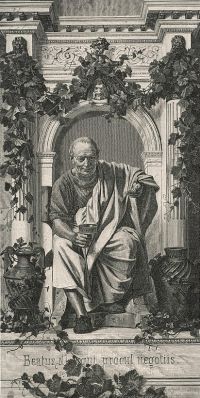
Portrait of Horace Horace The Odes and Carmen Saeculare of Horace

Tennyson's manner is not the manner of Horace, and it is the manner of a contemporary; the expression—a most powerful and beautiful expression—of influences to which a translator of an ancient classic feels himself to be too much subjected already. What is wanted is a metre which shall have other associations than those of the nineteenth century, which shall be the growth of various periods of English poetry, and so be independent of any. Such a metre is that which I have been led to choose, the eight-syllable iambic with alternate rhymes.
Source: Gutenberg

Portrait of Horace Horace The Odes and Carmen Saeculare of Horace

A tale till now by poet voice unsung.
As the Evian on the height,
Roused from her sleep, looks wonderingly abroad,
Looks on Thrace with snow-drifts white,
And Rhodope by barbarous footstep trod,
So my truant eyes admire
The banks, the desolate forests. O great King
Who the Naiads dost inspire,
And Bacchants, strong from earth huge trees to wring!
Not a lowly strain is mine,
No mere man's utterance.
Source: Gutenberg

Portrait of Horace Horace The Odes and Carmen Saeculare of Horace

Throughout the first half of the Ode, however, Horace has rather failed to mark the transitions of thought. He begins by assuring himself and, by implication, those whom he celebrates, of immortality, on the ground that the greatest poets are not the only poets; he then exchanges this thought for another, doubtless suggested by it, that the heroes of poetry are not the only heroes, though the very fact that there have been uncelebrated heroes is used to show that celebration by a poet is everything.
Source: Gutenberg

Get perspective with Kwize: daily news enlightened by great literature