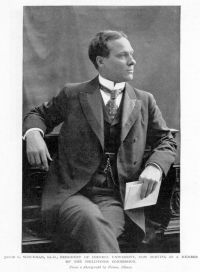
Jacob Gould Schurman

Jacob Gould Schurman

Summary

Portrait of Jacob Gould Schurman Jacob Gould Schurman The Philosophical Review (1892)

Spencer's ultimate identification of Justice with equal freedom is inadequate; for not only in the apportionment of freedom, but in the apportionment of all other benefits and of burdens must Justice be realized. Such perfect Justice cannot exist in a society in which the material means of life and happiness are in large part already appropriated. But the facts need not blind us to the ideal, which, indeed, is gradually conquering the facts.
Source: Wikisource

Portrait of Jacob Gould Schurman Jacob Gould Schurman The Philosophical Review (1892)

The receipt of the natural consequences of an individual's nature, active or quiescent, — wherein Mr. Spencer discovers the essence of Justice, — seems to me neither just nor unjust, neither right nor wrong, neither moral nor immoral. No doubt this process has made the later generations of animals stronger, more cunning, and better adapted to the environment than the earlier generations. And were we aiming at a similar improvement in the breed of man, we might perhaps not be able to do better than let the process of natural selection go on undisturbed.
Source: Wikisource

Portrait of Jacob Gould Schurman Jacob Gould Schurman The Philosophical Review (1892)

The state would then appear, not as a conventional, but a natural institution, in, and through which alone, man can lead a truly human life. It was no doubt formed for the protection of life; but, as Aristotle said, it exists for the improvement of life. Were there a world-state, its end would be the development and perfection of the life of mankind. It was this ultimate goal that Hegel probably had in mind when he defined morality and civilization — Sittlichkeit — as the end of the state. But the national state is the highest political community that has yet been reached.
Source: Wikisource

Get perspective with Kwize: daily news enlightened by great literature