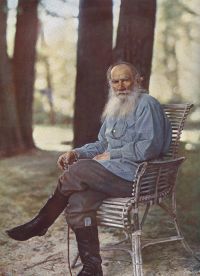
Leo Tolstoy

Leo Tolstoy

Pamphlets (1900)

Summary

Portrait of Leo Tolstoy Leo Tolstoy Pamphlets (1900)

The attempts to found a morality independent of religion are like the actions of children when, wishing to move a plant which pleases them, they tear off the root which does not please and seems unnecessary to them, and plant it in the earth without the root. Without religious foundation there can be no true, unsimulated morality, as without a root there can be no true plant. And so in reply to your two questions, I say religion is man's conception of his relation to the infinite universe, and to its source. And morality is the ever-present guide of life proceeding only from this relation.
Source: Wikisource

Portrait of Leo Tolstoy Leo Tolstoy Pamphlets (1900)

The men of our time, especially the learned, have grown so coarse that they, owing to their coarseness, are even unable to understand the significance and effect of spiritual force. A shell of fifty pounds of dynamite, fired at a crowd of living men—this they understand and recognise as a force; but thought, truth which has been realised and practised in the life, even to martyrdom, which has now become accessible to millions—this, according to their conception, is not a force, because it makes no noise, and one cannot see broken bones and pools of blood.
Source: Wikisource

Portrait of Leo Tolstoy Leo Tolstoy Pamphlets (1900)

The governments may and should fear those who refuse to serve, and, indeed, they are afraid of them, because every refusal undermines the prestige of the deceit by which the governments have the people in their power. But those who refuse have no ground whatever to fear a government that demands crimes from them. In refusing military service, every man risks much less than he would were he to enter it. The refusal of military service and the punishment—imprisonment, exile—is only an advantageous insurance of oneself against the dangers of the military service.
Source: Wikisource

Get perspective with Kwize: daily news enlightened by great literature