Summary

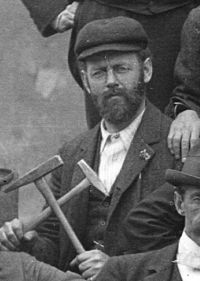
Portrait of James Furman Kemp James Furman Kemp 1911 Encyclopædia Britannica, Volume 18… (1911)

When we compare the first and second tabulations with the third it is at once apparent that with the possible although only occasional exception of iron the production of an ore-body from the normal rocks which constitute the outer mass of the earth requires the local concentration of each of the metals by one or several geological processes, and to a degree that is only occasionally developed in the ordinary course of nature.
Source: Wikisource

Portrait of James Furman Kemp James Furman Kemp 1911 Encyclopædia Britannica, Volume 18… (1911)

Faults often occur, moreover, in connexion with eruptive outbreaks, and therefore in circumstances especially favourable to ore deposition. From all these reasons it is not surprising that the “true fissure vein” based on a profound fault has been the ideal of the prospector’s search in many parts of the world, and has often been his reward. The historic veins of Cornwall and of Saxony are of this type, also the great silver veins of Mexico, the gold veins of California, the great silver-gold deposits of the Comstock lode, and many in South America.
Source: Wikisource

Portrait of James Furman Kemp James Furman Kemp 1911 Encyclopædia Britannica, Volume 18… (1911)

Native metals not being compounds were not considered ores. The product of the copper mines on Keweenaw Point, Lake Superior, was, and to a great extent is still, called copper rock rather than copper ore, and native gold in quartz is often described as gold quartz rather than gold ore, but these restrictions are gradually disappearing. An ore may therefore be defined as a metalliferous mineral or aggregate of metalliferous minerals mingled with a greater or less amount of barren materials called the “gangue,” and yet rich enough to be mined at a profit.
Source: Wikisource

Get perspective with Kwize: daily news enlightened by great literature