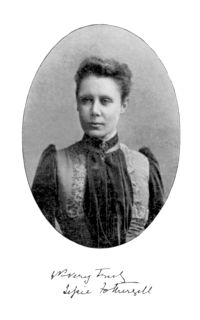
Jessie Fothergill

Jessie Fothergill

Summary

Portrait of Jessie Fothergill Jessie Fothergill The Wellfields: A novel. Vol. 2 of 3 (1880)

If he wished to recall to Nita’s mind their perils of the afternoon, he succeeded most thoroughly in doing so. It all rushed over her mind again, overpoweringly, and the whole truth of it. She knew as she heard his voice that never, never had life been so sweet as when, the danger over, she had seen Jerome Wellfield standing at her side, and had heard his voice, though scarcely comprehending what he said.
So he sang on, song after song; each one with fresh verve and fresh pleasure—with a purer delight in the exercise of his power.
Source: Gutenberg

Portrait of Jessie Fothergill Jessie Fothergill The Wellfields: A novel. Vol. 2 of 3 (1880)

Avice Wellfield, beside her, looked like an inhabitant of another world. It was the first time she had been out anywhere since her father’s death; and her plain black frock and white crêpe ruffles at neck and wrists formed a pointed contrast to Luise’s flashing colours and glittering rings and chains and bangles. Avice had plaited her hair up into a coronet, which gave her an older, staider look. The girl was fulfilling, more and more every day, Sara’s prophecy to her brother, that she would one day be beautiful.
Source: Gutenberg

Portrait of Jessie Fothergill Jessie Fothergill The Wellfields: A novel. Vol. 2 of 3 (1880)

I have a special fondness for the “still, sad music of humanity,” which one comprehends best at such times.’
‘Yes, it is a music worth listening to. But the music of humanity is not always sad, Herr Falkenberg, is it?’
‘No,’ said Rudolf, looking down at her. He was standing, Sara was seated on a low chair, leaning forward, and looking up at him with an earnest, large gaze, and in her eyes was so deep, so triumphant and secure a happiness, that he could not fail to see it—it made her face glorious with its reflection.
Source: Gutenberg

Get perspective with Kwize: daily news enlightened by great literature