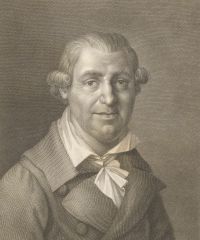
Johann Karl August Musäus

Johann Karl August Musäus

Summary

Portrait of Johann Karl August Musäus Johann Karl August Musäus Libussa, Duchess of Bohemia (1852)

On the day of All-Souls the young lady prepared herself, with the assistance of her faithful Abigail, to execute her plan: she pretended to be unwell, retired to her chamber, and metamorphorsed herself into the prettiest hobgoblin that ever tenanted this earth. The evening hours seemed to last longer than usual, and each moment augmented her desire to pass through the adventure. In the meanwhile that silent and discreet friend of lovers, the bright moon, illuminated with her pale light the castle of Lauenstein, where the bustle of the active day gave way insensibly to solemn silence.
Source: Wikisource

Portrait of Johann Karl August Musäus Johann Karl August Musäus Libussa, Duchess of Bohemia (1852)

That thought brought the long-neglected pedigree again to her recollection, and she was ashamed to have forgotten herself so far as to love a man without a name and without noble sentiments. When the influence of passion had ceased, she took advice from reason, how she should repair the error she had committed, and that faithful adviser counselled her to return to the castle, and bury in oblivion all thoughts of her faithless lover.
Source: Wikisource

Portrait of Johann Karl August Musäus Johann Karl August Musäus Libussa, Duchess of Bohemia (1852)

The heart of a young lady, as long as it submits to tuition, may be compared to a skiff upon a mirror-like sea, which can be steered any way the rudder propels it; but when the storm rages, and the waves swing it forward and backward, it no more obeys the rudder, but follows the course of the winds and waves. The tractable Emily was easily led by the motherly leading-strings upon the path of pride; her (as yet unprejudiced) heart was open to every impression. She expected a prince, or at least a count, would pay homage to her attractions
Source: Wikisource

Get perspective with Kwize: daily news enlightened by great literature