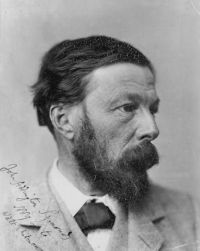
John Addington Symonds

John Addington Symonds

Summary

Portrait of John Addington Symonds John Addington Symonds New Italian sketches

I do not know why these sea-urchins are so far more irrepressible than their land brethren. But it is always thus in Italy. They take an imperturbable delight in noise and mere annoyance. I shall never forget the sea-roar of Porto Venere, with that shrill obbligato, "Soldo, soldo, soldo!" rattling like a dropping fire from lungs of brass.
At the end of Porto Venere is a withered and abandoned city, climbing the cliffs of S. Pietro; and on the headland stands the ruined church, built by Pisans with alternate rows of white and black marble, upon the site of an old temple of Venus.
Source: Gutenberg

Portrait of John Addington Symonds John Addington Symonds New Italian sketches

Lying awake in Venice, when the wind blows hard, one hears the sea thundering upon its sandy barrier, and blesses God for the murazzi. On such a night it happened once to me to dream a dream of Venice overwhelmed by water. I saw the billows roll across the smooth lagoon like a gigantic Eager. The Ducal Palace crumbled, and San Marco's domes went down. The Campanile rocked and shivered like a reed. And all along the Grand Canal the palaces swayed helpless, tottering to their fall, while boats piled high with men and women strove to stem the tide, and save themselves from those impending ruins.
Source: Gutenberg

Portrait of John Addington Symonds John Addington Symonds New Italian sketches

It is possible that the absence of blue makes the St. Catherine frescos in the Monastero Maggiore at Milan surpass all other works of Luini. But nowhere else has he shown more beauty and variety in detail than here. The group of women led by Joseph, the shepherd carrying the lamb upon his shoulder, the girl with a basket of white doves, the child with an apple on the altar-steps, the lovely youth in the foreground heedless of the scene; all these are idyllic incidents treated with the purest, the serenest, the most spontaneous, the truest, most instinctive sense of beauty.
Source: Gutenberg

Get perspective with Kwize: daily news enlightened by great literature