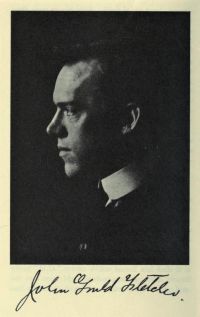
John Gould Fletcher

John Gould Fletcher

Summary

Portrait of John Gould Fletcher John Gould Fletcher Goblins and Pagodas

War breaks out, not alone in the external world, but in the artist's soul. He finds he must follow his personality wherever it leads him, despite all obstacles. This is the "Orange Symphony."
Now follow long years of struggle and neglect. He is shipwrecked, and still afar he sees his city of art, but this time it is red, a phantom mocking his impotent rage.
Old age follows. All is violet, the colour of regret and remembrance. He is living only in the past, his life a succession of dreams.
Source: Gutenberg

Portrait of John Gould Fletcher John Gould Fletcher Goblins and Pagodas

In fact, literature existed before writing; and writing in itself is of no value from the purely literary sense, except in so far as it preserves and transmits from generation to generation the literary emotion. Style, whether in prose or poetry, is an attempt to develop this essentially musical quality of literature, to evoke the magic that exists in the sound-quality of words, as well as to combine these sound-qualities in definite statements or sentences. The difference between prose and poetry is, therefore, not a difference of means, but of psychological effect and reaction.
Source: Gutenberg

Portrait of John Gould Fletcher John Gould Fletcher Goblins and Pagodas

The fundamental tenets of thought, art, life itself, have been shaken: and either civilization is destined to some new birth, or mankind will revert to the conditions of life, thought, and social intercourse that prevailed in the Stone Age.
Like all men of my generation, I have not been able to resist this irresistible upheaval of ideas and of forces: and, to the best of my ability, I have tried to arrive at a clear understanding of the fundamentals of æsthetic form as they affect the art to which I have felt myself instinctively akin, the art of poetry.
Source: Gutenberg

Get perspective with Kwize: daily news enlightened by great literature