Summary

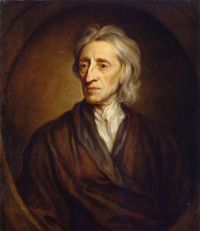
Portrait of John Locke John Locke An Essay Concerning Human Understanding…

Motion proves a vacuum. But not to go so far as beyond the utmost bounds of body in the universe, nor appeal to God’s omnipotency to find a vacuum, the motion of bodies that are in our view and neighbourhood seems to me plainly to evince it. For I desire any one so to divide a solid body, of any dimension he pleases, as to make it possible for the solid parts to move up and down freely every way within the bounds of that superficies, if there be not left in it a void space as big as the least part into which he has divided the said solid body.
Source: Wikisource

Portrait of John Locke John Locke An Essay Concerning Human Understanding…

To conclude : whatever men shall think concerning the existence of a vacuum, this is plain to me – that we have as clear an idea of space distinct from solidity, as we have of solidity distinct from motion, or motion from space. We have not any two more distinct ideas ; and we can as easily conceive space without solidity, as we can conceive body or space without motion, though it be never so certain that neither body nor motion can exist without space. But whether any one will take space to be only a relation resulting from the existence of other beings at a distance
Source: Wikisource

Portrait of John Locke John Locke An Essay Concerning Human Understanding…

Extension being inseparable from body, proves it not the same. It is true, the idea of extension joins itself so inseparably with all visible, and most tangible qualities, that it suffers us to see no one, or feel very few external objects, without taking in impressions of extension too. This readiness of extension to make itself be taken notice of so constantly with other ideas, has been the occasion, I guess, that some have made the whole essence of body to consist in extension
Source: Wikisource

Get perspective with Kwize: daily news enlightened by great literature