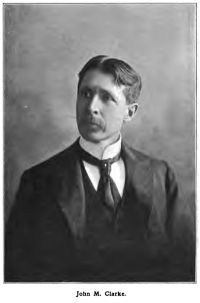
John Mason Clarke

John Mason Clarke

Summary

Portrait of John Mason Clarke John Mason Clarke The Eurypterida of New York (1912)

The long curved spines (s, s, s) , are a very curious feature of the appendage and the most marked character of the genus and species. They are articulated to the posterior margin of the joints, as the latter rest flattened out in the slate or shale, and there is no evidence but that they form a single series as shown in the specimen and in the drawing, figure 2. Each spine is constricted a little near its base, forming a rounded end or point of articulation; from this well out toward their pointed termination they retain an average width curving gently backward and inward.
Source: Wikisource

Portrait of John Mason Clarke John Mason Clarke The Eurypterida of New York (1912)

In the Old Red sandstone of the Devonian both in Europe and America a similar association obtained. A most extraordinary group of fishes and a family of most gigantic crustaceans flourished where marine life found only an occasional and meager presence. These few marine forms, here and there in a massive deposit, no more imply prevalent salt water than the present marine species in the bay of San Francisco imply that the gravels, sands and silts of the valley of California and of the Great Basin, which seem to be analogues of the Old Red sandstone, are prevailingly marine.
Source: Wikisource

Portrait of John Mason Clarke John Mason Clarke The Eurypterida of New York (1912)

On the other hand, these hind legs show none of those characters which naturally accompany a swimming function, such as a widening of the joints and an intricate articulation insuring rigidity of the legs, while the preceding legs, in some species as S. cestrotus, are provided with a dense fringe of contiguous spines or bristles well adapted to broaden the swimming surface of the limbs. To the first leg of S. excelsior which is the only one observed, paired flat spines are attached whose form suggests their adaptation to swimming. We are disposed to regard all legs as adapted for crawling.
Source: Wikisource

Get perspective with Kwize: daily news enlightened by great literature