“ I hold a watch near the flame: nobody hears its ticks; but you all see their effect upon the flame. At every tick it falls and roars. The winding up of the watch also produces tumult. The twitter of a distant sparrow shakes the flame; the note of a cricket would do the same. A chirrup from a distance of 30 yards causes it to fall and roar. ”
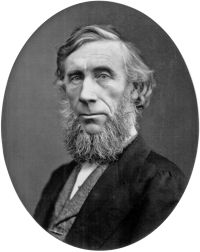
John Tyndall
Summary
John Tyndall’s Sound, a scientific treatise from the 19th century, investigates the physical properties of acoustics through experiments and theoretical examination. Concentrating on oscillations, waves, and the conveyance of sound through air and solids, Tyndall analyzes phenomena such as the interaction of sound with flames, the speed of sound waves, and the dynamics of musical tones. Employing striking demonstrations—such as a watch’s ticking disturbing a flame—he shows how imperceptible vibrations produce visible effects.
The work highlights the relationship between perception and physical reality, contending that scientific education should nurture the capacity to envision invisible forces. By analyzing the structure of sound waves and their movement through tubes, strings, and air, Tyndall connects sensory experience with the abstract mechanisms of nature, maintaining that comprehending sound demands both empirical observation and imaginative abstraction.
Quotes from Sound (John Tyndall)
“ The only condition necessary to the production of a musical sound is that the pulses should succeed each other in the same interval of time. No matter what its origin may be, if this condition be fulfilled the sound becomes musical. If a watch, for example, could be caused to tick with sufficient rapidity—say one hundred times a second—the ticks would lose their individuality and blend to a musical tone. And if the strokes of a pigeon’s wings could be accomplished at the same rate, the progress of the bird through the air would be accompanied by music. ”
“ We begin slowly, we gradually increase the rapidity, until finally the succession of the beats is so rapid as to produce that particular grating effect which every musician that hears it would call dissonance. Let us now reverse the process, and pass from these quick beats to slow ones. The same continuity of the phenomenon is noticed. By degrees the beats separate from each other more and more, until finally they are slow enough to be counted. Thus these singing-flames enable us to follow the beats with certainty, until they cease to be beats and are converted into dissonance. ”
