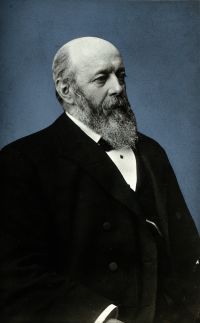
John Gray McKendrick

John Gray McKendrick

Summary

Portrait of John Gray McKendrick John Gray McKendrick 1911 Encyclopædia Britannica (1911)

It depends on the fact that many waves of sound that reach the ear are compound wave systems, built up of constituent waves, each of which is capable of exciting a sensation of a simple tone if it be singled out and reinforced by a resonator (see Sound) , and which may sometimes be heard without a resonator, after special practice and tuition. Thus it appears that the ear must have some arrangement by which it resolves every wave system, however complex, into simple pendular vibrations. When we listen to a sound of any quality we recognize that it is of a certain pitch.
Source: Wikisource

Portrait of John Gray McKendrick John Gray McKendrick 1911 Encyclopædia Britannica (1911)

The half-closed eyelids tend more and more to close; the inspirations become slower and deeper; the muscles supporting the lower jaw become relaxed, so that the mouth opens; the muscles of the back of the neck that tend to support the head also relax and the chin droops on the breast; and the limbs relax and tend to fall into a line with the body. At the same time the hesitating utterances of the sleepy man indicate vagueness of thought, and external objects gradually cease to make an impression on the senses. These are the chief phenomena of the advent of sleep.
Source: Wikisource

Portrait of John Gray McKendrick John Gray McKendrick 1911 Encyclopædia Britannica (1911)

The coincidence of the time of sleep with the occurrence of the great terrestrial phenomena that cause night is more apparent than real. The oscillations of vital activity are not correlated to the terrestrial revolutions as effect and cause, but the occurrence of sleep, in the majority of cases, on the advent of night is largely the result of habit. Whilst the darkness and stillness of night are favourable to sleep, the state of physiological repose is determined more by the condition of the body itself. Fatigue will normally cause sleep at any time of the twenty-four hours.
Source: Wikisource

Get perspective with Kwize: daily news enlightened by great literature