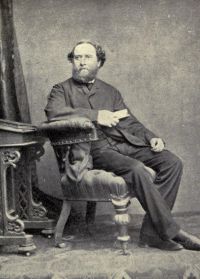
John Westland Marston

John Westland Marston

Summary

Portrait of John Westland Marston John Westland Marston Dictionary of National Biography… (1886)

Bowles's proposition that 'images drawn from what is beautiful or sublime in nature are more sublime and beautiful than images drawn from art, and that they are therefore per se more poetical, and that passions are more adapted to poetry than manners,' is by no means refuted by Campbell's assertion that 'the exquisite description of artificial objects and manners is no less characteristic of genius than the description of physical appearances.' Bowles never denied that many artificial objects are beautiful.
Source: Wikisource

Portrait of John Westland Marston John Westland Marston Dictionary of National Biography… (1886)

Byron's instances, in opposition to Bowles, go chiefly to show that certain natural objects are less interesting than certain artificial ones, and that by laws of association the latter at times, especially when unfamiliar, strike us more than the former, though intrinsically superior, when custom has lessened their effect. The doctrine of Bowles is not shaken by either of his principal antagonists. If it exclude Pope from the small band of the very highest poets, his critic nevertheless declares that in the second rank none were superior to him.
Source: Wikisource

Portrait of John Westland Marston John Westland Marston Dictionary of National Biography… (1886)

But for the union of Defoe-like truth of description with poetic touches that render the truth more vivid, and for a sympathetic imagination which, in dealing with human motives and passions, often seems to anticipate experience, Oliver Madox-Brown must stand in the van of young writers, who not only surprise by the brilliancy of their work, but retain admiration by its solidity. The 'Literary Remains' contain, besides the works already named as included, the writer's poems.
Source: Wikisource

Get perspective with Kwize: daily news enlightened by great literature