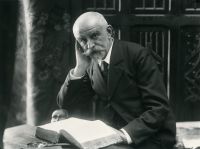
Joris-Karl Huysmans

Joris-Karl Huysmans

Summary

Portrait of Joris-Karl Huysmans Joris-Karl Huysmans,  The Cathedral — Chapter X

“ Then there is another plant which seems to me no less appropriate: the bracken—not by reason of the qualities ascribed to it by Saint Hildegarde, but because it symbolizes the most secret and retiring humility. Take one of the stoutest stems and cut it aslant, like the mouthpiece of a whistle, and you will find very distinctly imprinted in black the form of a heraldic fleur de lys, as if stamped with a hot iron. The scent being absent, we may here accept it as the symbol of humility—a humility so perfect that it is undiscoverable but in death. ”
Source: Wikisource

Portrait of Joris-Karl Huysmans Joris-Karl Huysmans,  The Cathedral — Chapter X

“ It abounds in Syria, round Jerusalem, in Galilee, on the Mount of Olives; rising from a tuft of deeply-cut, alternate leaves of a rich, dull green, the flower cup is like a delicate and refined poppy; it has the air of a patrician among flowers, of a little Infanta, fresh and innocent in her gorgeous attire."
"It is certainly the fact," observed Durtal, "that the innocence of the lily is far from obvious, for its scent, when you think of it, is anything rather than chaste.
”
Source: Wikisource

Portrait of Joris-Karl Huysmans Joris-Karl Huysmans,  The Cathedral — Chapter X

“ That is, to make a liturgical garden, a true Benedictine garden, where flowers may be grown in succession for the sake of their relations to the Scriptures and hagiology. Would it not be delightful to follow out the liturgy of prayer with that of plants, to place them side by side in the sanctuary, to deck the altars with flowers all having their meanings according to the days and festivals; in short, to associate nature in its most exquisite manifestation—that is, its flowers—with the ceremonies of divine worship? ”
Source: Wikisource

Get perspective with Kwize: daily news enlightened by great literature