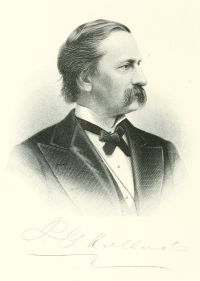
Josiah Gilbert Holland

Josiah Gilbert Holland

Summary

Portrait of Josiah Gilbert Holland Josiah Gilbert Holland The Life of Abraham Lincoln (Holland… (1866)

Must they be allowed to finally fail of execution, even had it been perfectly clear that by the use of the means necessary to their execution some single law, made in such extreme tenderness of the citizen's liberty, that, practically, it relieves more of the guilty than the innocent, should, to a very limited extent, be violated? To state the question more directly: are all the laws but one to go unexecuted, and the government itself go to pieces, lest that one be violated?
Source: Wikisource

Portrait of Josiah Gilbert Holland Josiah Gilbert Holland The Life of Abraham Lincoln (Holland… (1866)

The sophism itself is, that any state of the Union may, consistently with the national Constitution, and therefore lawfully and peacefully, withdraw from the Union without the consent of the Union, or of any other state. The little disguise that the supposed right is to be exercised only for just cause, themselves to be the sole judges of its justice, is too thin to merit any notice.
Source: Wikisource

Portrait of Josiah Gilbert Holland Josiah Gilbert Holland The Life of Abraham Lincoln (Holland… (1866)

Lincoln held the Union sovereign and the state subject. A state had no right to coerce a nation into dissolution, any more than a county had a right to force a state into dissolution. He maintained that the United States were a nation, one and indivisible, and that any attempt to dissolve it on the part of a state, or a combination of states, was treason. Here was where the Union and the new confederacy separated. The confederacy was a logical result of the doctrine of state rights, and its destruction, by all the power of the federal government, was the logical necessity of its contravention.
Source: Wikisource

Get perspective with Kwize: daily news enlightened by great literature