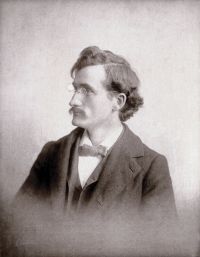
L. H. Bailey

L. H. Bailey

Summary

Portrait of L. H. Bailey L. H. Bailey,  Beginners' botany (1921)

“ A generation begins with the young seed, not with germination. [17] It ends with death—that is, when no life is left in any part of the plant, and only the seed or spore remains to perpetuate the kind. In a bulbous plant, as a lily or an onion, the generation does not end until the bulb dies, even though the top is dead.
When the generation is of only one season’s duration, the plant is said to be annual. When it is of two seasons, it is biennial. Biennials usually bloom the second year.
”
Source: Gutenberg

Portrait of L. H. Bailey L. H. Bailey,  Beginners' botany (1921)

“ The sum of all the conditions in which a plant or an animal is placed is called its environment, that is, its surroundings. The environment comprises the conditions of climate, soil, moisture, exposure to light, relation to food supply, contention with other plants or animals. ”
Source: Gutenberg

Portrait of L. H. Bailey L. H. Bailey,  Beginners' botany (1921)

“ When animals breathe the air once, they make it foul, because they use some of the oxygen and give off carbon dioxide. Likewise, all living parts of the plant must have a constant supply of oxygen. Roots also need it, for they respire. Air goes in and out of the soil by diffusion, and as the soil is heated and cooled, causing the air to expand and contract.
The oxygen passes into the air-spaces and is absorbed by the moist cell membranes. In the living cells it makes possible the formation of simpler compounds by which energy is released.
”
Source: Gutenberg

Get perspective with Kwize: daily news enlightened by great literature