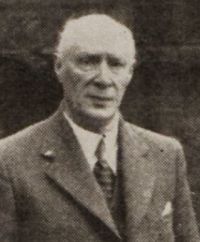
Lewis Spence

Lewis Spence

Summary

Portrait of Lewis Spence Lewis Spence The Myths of Mexico and Peru (1913)

In G we may be sure that we have found a sun-god par excellence. His hieroglyph is the sun-sign, kin. But we must be careful not to confound him with deities like Quetzalcoatl or Kukulcan. He is, like the Mexican Totec, the sun itself, and not the Man of the Sun, the civilising agent, who leaves his bright abode to dwell with man and introduce him to the arts of cultured existence. He is the luminary himself, whose only acceptable food is human blood, and who must be fed full with this terrible fare or perish, dragging the world of men with him into a fathomless abyss of gloom.
Source: Wikisource

Portrait of Lewis Spence Lewis Spence The Myths of Mexico and Peru (1913)

How much more fascinating would American history have been had Asia sowed the seeds of her own peculiar civilisation in the western continent, which would then have become a newer and further East, a more glowing and golden Orient! But America possesses a fascination almost as intense when there falls to be considered the marvel of the evolution of her wondrous civilisations—the flowers of progress of a new, of an isolated world.
Source: Wikisource

Portrait of Lewis Spence Lewis Spence The Myths of Mexico and Peru (1913)

Here dwelt the sacred women, the chief of whom, like their male prototypes, were dedicated to Kukulcan and regarded with much reverence. The base of the building is occupied by eight large figures, and over the door is the representation of a priest with a panache, whilst a row of gigantic heads crowns the north façade. Here, too, are figures of the wind-god, with projecting lips, which many generations of antiquarians took for heads of elephants with waving trunks! The entire building is one of the gems of Central American architecture, and delights the eye of archaeologist and artist alike.
Source: Wikisource

Get perspective with Kwize: daily news enlightened by great literature