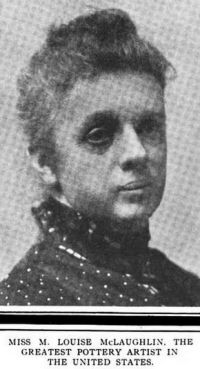
M. Louise McLaughlin

M. Louise McLaughlin

Summary

Portrait of M. Louise McLaughlin M. Louise McLaughlin Pottery decoration under the glaze (1880)

The process of glazing has a tendency to soften and melt the tints into each other, but this effect must be enhanced by judicious use of the middle tints and shadows of the painting, and by leaving the edges thin. One of the greatest beauties of this kind of painting, when well done, is the effect of the rich colors melting into each other, with a charming indistinctness, which leaves something to the imagination of the beholder.
Those who have not been accustomed to the use of color in such masses, will, perhaps, be embarrassed at first by the difficulty of painting with clay.
Source: Gutenberg

Portrait of M. Louise McLaughlin M. Louise McLaughlin Pottery decoration under the glaze (1880)

As to the clay forming the body of the ware, it must be of such a nature as to adapt itself to a glaze sufficiently soft to preserve the colors. As the clay used in the painting must, of necessity, in most cases, be white, in order that the purity and beauty of the colors may not be affected by admixture with it, a body of the same, or very nearly resembling it, would, in some respects, be the best, one reason for this being that the applied clay would be more certain to adhere firmly to the body, both having the same qualities.
Source: Gutenberg

Get perspective with Kwize: daily news enlightened by great literature