“ By day Thou are the Legend and the Dream That like a whisper floats about all men, The deep and brooding stillnesses which seem, After the hour has struck, to close again. And when the day with drowsy gesture bends And sinks to sleep beneath the evening skies, As from each roof a tower of smoke ascends— So does Thy Realm, my God, around me rise. All those who seek Thee tempt Thee, And those who find would bind Thee To gesture and to form. But I would comprehend Thee As the wide Earth unfolds Thee. Thou growest with my maturity, Thou Art in calm and storm. ”
Summary
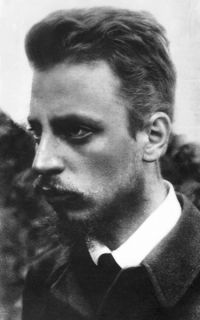
“Poems”, is a work by Rainer Maria Rilke. It explores elements such as poems, The Book of Hours and poet.
Quotes from Poems (Rainer Maria Rilke)
“ There is a period in the life of every artist when his whole being seems lost in a contemplation of the surrounding world, when the application to work is difficult, like the violent forcing of something that is awaiting its time. This is the time of his dream, as sacred as the days of early spring before wind and rain and light have touched the fruits of the fields, when there is a tense bleak silence over the whole of nature, in which is wrapped the strength of storms and the glow of the summer's sun. ”
“ Rodin became to Rilke the manifestation of the divine principle of the creative impulse in man. Thus Rilke's monograph on Auguste Rodin will remain the poet's testament on Life and Art.Rilke has lived deeply; he has absorbed into his artistic and spiritual consciousness many of the supreme values of our time. His art holds the mystic depth of the Slav, the musical strength of the German, and the visual clarity of the Latin. As artist, he has felt life to be sacred, and as a priest, he has brought to its altar many offerings. ”
“ Poetry is reality's essence visioned and made manifest by one endowed with a perception acutely sensitive to sound, form, and colour, and gifted with a power to shape into rhythmic and rhymed verbal symbols the reaction to Life's phenomena. The poet moulds that which appears evanescent and ephemeral in image and in mood into everlasting values. In this act of creation he serves eternity.Poetry, in especial lyrical poetry, must be acknowledged the supreme art, culminating as it does in a union of the other arts, the musical, the plastic, and the pictorial. ”
“ Of Russia and its influence upon him, Rilke writes: "Russia became for me the reality and the deep daily realization that reality is something that comes infinitely slowly to those who have patience. Russia is the country where men are solitary, each one with a world within himself, each one profound in his humbleness and without fear of humiliating himself, and because of that truly pious. Here the words of men are only fragile bridges above their real life."The great symbols of Solitude and of Death enter into the poet's work. ”
“ For this reason the book on Rodin is far more than a purely æsthetic valuation of the sculptor's work; Rilke traces throughout the book the strongly ethical principle which works itself out in every creative act in the realm of art. This grasp of the deeper significance of all art gives to the book on Rodin its well-nigh religious aspect of thought and its hymnlike rhythm of expression. He begins: "Rodin was solitary before fame came to him, and afterward he became perhaps still more solitary. For fame is ultimately but the summary of all misunderstandings that crystallize about a new name." ”
“ It is the impatience to burst into blossoming, the longing for love which pulsates in these Songs of the Maidens with the tenseness of suspense. The Prayers of the Maidens to Mary have not the mild melody of maidenly prayer; they vibrate with the ecstasy of expectant life, and the Madonna is more than the Heavenly Virgin, their longing transforms her into the symbol of earthly love and motherhood. ”
“ In The Book of Hours, Rilke withdraws from the world not from weariness but weighed down under the manifold conflicting visions. As the prophet who would bring to the world a great possession must go forth into the desert to be alone until the kingdom comes to him from within, so the poet must leave the world in order to gain the deeper understanding, to be face to face with God. The mood of Das Stunden-Buch is this mood of being face to face with God; it elevates these poems to prayer, profound prayer of doubt and despair, exalted prayer of reconciliation and triumph. ”
“ One recalls the broad, solidly-built figure of Rodin with his rugged features and high, finely chiselled forehead, moving slowly among the white glistening marble busts and statues as a giant in an old legend moves among the rocks and mountains of his realm, patient, all-enduring, the man who has mastered life, strong and tempered by the storms of time. ”
“ The motif of The Monk's Life is expressed in the poem beginning with the lines: "I live my life in circles that grow wide And endlessly unroll."Through the grey cell of the young Monk there flash in luminous magnificence the colours of the great renaissance masters, for he feels in Titian, in Michelangelo, in Raphael the same fervour that animates him; they, too, are worshippers of the same God.There are poems in The Book of Pilgrimage of the stillness of a whispered prayer in a great Cathedral and there are others that carry in their exultation the music of mighty hymns. ”
“ Modern Paris is often the background of the New Poems, and the crass play of light and shadow upon the waxen masks of Life's disillusioned in the Morgue is caught with the same intense realistic vision as the flamingos and parrots spreading their vari-coloured soft plumage in the warmth of the sun in the Avenue of the Jardin des Plantes. ”
“ Up to the time of the publication of these volumes, Rilke's poems possessed a quietude, a stillness suggested in the straight unbroken yet delicate lines of the picture which he portrays and in the soft, almost unpulsating rhythm of his words. The approach of evening or nightfall, the coming of dawn, the change of the seasons, the slow changes of light into darkness and of darkness into light, in short, the most silent yet greatest metamorphoses in the external aspects of nature form the contents of many of these first poems. ”
“ The inanimate object and the living creature in nature are not seen in the sharp contours of their isolation; they are viewed and interpreted in the atmosphere that surrounds them, in which they are enwrapped and so densely veiled that the outlines are only dimly visible, be that atmosphere the mystic grey of northern twilight or the dark velvety blue of southern summer nights. ”
“ In this phase of Rilke's development, the principle of renunciation constitutes a certain negative element in his philosophy. The poet later proceeded to a positive acquiescence toward man's possessions, at least those acquired or created in the domain of art.In our approach through the mystic we touch reality most deeply. It is because of this that all art and all philosophy culminate in their final forms in a crystallization of those values of life that remain forever inexplicable to pure reason; they become religious in the simple, profound sense of that word. ”
“ Sometime it will be realized what has made this great artist so supreme. He was a worker whose only desire was to penetrate with all his forces into the humble and the difficult significance of his tool. Therein lay a certain renunciation of life but in just this renunciation lay his triumph—for Life entered into his work. ”
“ The last part of The Book of Hours, The Book of Poverty and Death, is finally a symphony of variations on the two great symbolic themes in the work of Rilke. As Christ in the parable of the rich young man demands the abandonment of all treasures, so in this book the poet sees the coming of the Kingdom, the fulfilment of all our longings for a nearness to God when we have become simple again like little children and poor in possessions like God Himself. ”
“ Through all these poems there sounds like a subdued accompaniment a note of gratitude for the ability to thus vision the world, to be sunk in the music of all things. "Without is everything that I feel within myself, and without and within myself everything is immeasurable, illimitable." ”
“ The meadows, the maidens, the dark river in the evening, the spires of the cathedral at night rising like grey mists are seen with a wonderment, the great well-spring of all poetic imagination, with a well-nigh religious piety. ”
“ More vital than the influence of the personalities and the art treasures of the countries which Rilke visited and more potent in its effect upon his creations, like a great sun over the most fruitful years of his life, stands the towering personality of Auguste Rodin. The New Poems bear the dedication: "A mon grand ami, Auguste Rodin," indicating the twofold influence which the French sculptor wielded over the poet, that of a friend and that of an artist. ”
“ The gesture, the movement begins in Advent and Celebration to disturb the stillness prevailing in the first two volumes of poems. Even here it is only gentle and shy at first like the stirring of a breath of wind over a quiet sea; and gentle beings make this first gesture, children and young women at play, singing, dancing or at prayer.Particularly in the cycle Songs of the Maidens in the book Celebration, the atmosphere is condensed and becomes the psychic background of the landscape against which the gesture of longing or expectation is seen and felt. ”
“ History defines and directs its physical course, science cooperates in the achievement of its material aims, but Art alone gives to the age its spiritual physiognomy, its ultimate and lasting expression.The process of Art is on the one hand sensuous, the conception having for its basis the fineness of organization of the senses; and on the other hand it is severely scientific, the value of the creation being dependent upon the craftsmanship, the mastery over the tool, the technique. ”
“ The most eminent contemporary poets of Europe have, each in accordance with his individual temperament, reflected in their work the spiritual essence of our age, its fears and failures, its hopes and high achievements: Maeterlinck, with his mood of resignation and his retirement into a dusky twilight where his shadowy figures move noiselessly like phantoms in fate-laden dimness ”
“ With Advent and Mir Zur Feier, both published within the following three years, a phase of questioning commences, a dim desire begins to stir to reach out into the larger world "deep into life, out beyond time." Whereas the early poems were characterized by a tendency to turn away from the turmoil of life—in fact, the concrete world of reality does not seem to exist—there is noticeable in these two later volumes an advance toward life in the sense that the poet is beginning to approach and to vision some of its greatest symbols. ”
“ These pictures of town and landscape are never separated from their personal relation to the poet. He feels too keenly his dependence upon them, as a child views flowers and stars as personal possessions. Not until later was he to reach the height of an impersonal objectivity in his art. What distinguishes these early poems from similar adolescent productions is the restraint in the presentation, the economy and intensity of expression and that quality of listening to the inner voice of things which renders the poet the seer of mankind. ”
“ If, as has been said with a degree of verity, Nietzsche was primarily a musician whose philosophy had for its basis and took its ultimate aspects from the musical quality of his artistic endowment, it may be maintained with an equal amount of truth that Rilke is primarily a painter and sculptor whose poetry rests upon the fundaments of the pictorial and plastic arts. ”
“ With both beauty of detail and problematic interest, the short stories show an incoherence of treatment and a lack of dramatic co-ordination easily conceivable in a poet who is essentially lyrical and who at that time had not mastered the means of technique to give to his characters the clear chiselling of the epic form.A sojourn in Russia and especially the acquaintance with the novels of Dostoievsky became potent factors in Rilke's development and served to deepen creations which without this influence might have terminated in a grandiose æsthesia. ”
“ Before the eternal facts of Life doubt and strife are reconciled into faith, will and pride change into humility. The realization of this truth expressed in the medium of poetry is the significance of Rilke's Book of Hours. ”
“ Art, like Nature, its great and only reservoir for all time past and all time to come, ever strives for elimination and selection. It is severe and aristocratic in the application of its laws and impervious to appeal to serve other than its own aims. ”
“ In Advent, the experience of the atmosphere becomes an experience in his innermost soul and, therefore, all things become of value to him only in so far as they partake of the atmosphere, as they are seen in a peculiar air and distance. This first phase in Rilke's work may be defined as the phase of reposeful nature. ”
“ Broadly speaking, Russian art and literature may be described as springing from an ethical impulse and as having for their motive power and raison d'être the tendency toward socio-political reform, in contradistinction to the art and literature of Western culture, whose motives and aims are primarily of an æsthetic nature and seek in art the reconciliation of the dualism between spirit and matter. ”
“ The spirit of the Middle Ages with its religious fervour and superstitious fanaticism is symbolized in several poems, the most important among which are The Cathedral, God in the Middle Ages, Saint Sebastian personifying martyrdom, and The Rose Window, whose glowing magic is compared to the hypnotic power of the tiger's eye. ”
“ In his subsequent poetic work Rilke did not again reach the sustained high quality of this book, the mood and idea of which he incorporated into a prose work of exquisite lyrical beauty: The Sketch of Malte Laurids Brigge.In New Poems (1907) and New Poems, Second Part (1908) the historical figure, frequently taken from the Old Testament, has grown beyond the proportions of life; it is weightier with fate and invariably becomes the means of expressing symbolically an abstract thought or a great human destiny. Abishag presents the contrast between the dawning and the fading life ”
“ In the first decade of the new century Rilke reached the height of his art and with a few exceptions the poems represented in this volume are selected from the poems which were published between the years 1900 and 1908. The ascent toward the acme of Rilke's art after the year 1900 is as rapid as it is precipitous. Only a few years previous we read in Advent: "That is longing: To dwell in the flux of things, To have no home in the present. ”
“ David Singing Before Saul shows the impatience of awakening ambition, and Joshua is the man who forces even God to do his will. The antique Hellenic world rises with shining splendour in the poems Eranna to Sappho, Lament for Antinous, Early Apollo and the Archaic Torso of Apollo. ”
“ There are in The Book of Pictures poems in which this will to concentrate a mood into its essence and finality is applied to purely lyrical poems as in Initiation, that stands out in this volume like "the great dark tree" itself so immeasurable is the straight line of its aspiration reaching into the far distant silence of the night ”
