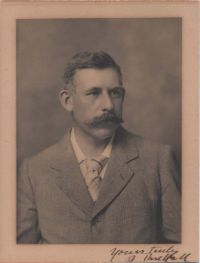
Richard Threlfall

Richard Threlfall

Summary

Portrait of Richard Threlfall Richard Threlfall On Laboratory Arts

Hale of the Kenwood Observatory tells me he cannot do any good prominence photography unless his objective has a clean surface; indeed every observer of faint objects or delicate planetary markings knows full well the value of a dark field free from diffused light. The object-glass maker uses his best efforts to produce the most perfect polish on his lenses, aside from the accuracy of the curves, both for high light value and freedom from diffused light in the field, and if the surfaces are allowed to become covered with dust, his good work counts for little.
Source: Gutenberg

Portrait of Richard Threlfall Richard Threlfall On Laboratory Arts

I ought to add that not the least remarkable fact about the polishing is the extraordinarily small quantity of the polishing material requisite, which suggests that the process of polishing is not by any means the same as that of exceptionally fine grinding. Is it possible that the chief proximate cause of the utility of rouge is to be sought in its curious property of adhering to a rough glass surface, causing it, so to speak, to drag the glass off in minute quantities, and redeposit it after a certain thickness has been attained on another part of the surface?
Source: Gutenberg

Portrait of Richard Threlfall Richard Threlfall On Laboratory Arts

Perhaps the easiest way of making such a joint is to use an outer tube of thin clean glass, and bore a narrow hole into it from one side to admit the mercury; if the mercury is to be heated in vacuo, it is better to seal on a side joint. It is always better, if possible, to boil the mercury in situ, which involves making the wrapping of asbestos, but, after all, we come back to the position I began by taking up, viz. that the easiest and most reliable method is by fusion of the glass — all the rest are unsuitable for work of real precision.
Source: Gutenberg

Get perspective with Kwize: daily news enlightened by great literature