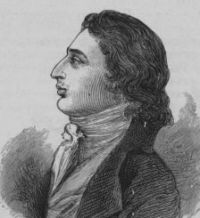
Robert Southey

Robert Southey

Summary

Portrait of Robert Southey Robert Southey The doctor, &c., vol. 5 (of 7) (1834)

Numerous prose indeed not only carries with it a charm to the ear but affords such facility to the utterance, that the difference between reading aloud from a book so composed, or from one which has been written without any feeling of numerousness on the writer's part, is as great and perceptible as the difference between travelling upon an old road, or a macadamized one. Twenty pages of the one will exhaust the reader more than threescore of the other, just as there was more fatigue in a journey of fifty miles, fifty years ago, than there is in thrice the distance now.
Source: Gutenberg

Portrait of Robert Southey Robert Southey The doctor, &c., vol. 5 (of 7) (1834)

But how could any such fear have led to the worship of Fetishes? How could a Savage, seized with terror, ever have believed that an onion, a stone, a flower, water, a tree, a mouse, a cat, &. could be his protector and secure him against all that he apprehended? I know that fear does not reason, but it is not to be understood in this sense; we frequently fear something without knowing why; but when we address ourselves to a Protector we always know why, it is in the persuasion that he can defend us, a persuasion which has always a foundation,—a basis. But in Fetish worship where is the motive?
Source: Gutenberg

Portrait of Robert Southey Robert Southey The doctor, &c., vol. 5 (of 7) (1834)

Nobs was as precious a horse to the Doctor as Vegliantino was to Rinaldo,—that noble courser whom the Harpies killed, and whom Rinaldo, after killing the whole host of Harpies, buried sorrowfully, kneeling down and kissing his grave. He intended to go in mourning and afoot for his sake all the rest of his life, and wrote for him this epitaph upon a stone, in harpy's blood and with the point of his sword.
Source: Gutenberg

Get perspective with Kwize: daily news enlightened by great literature