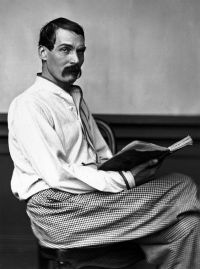
Sir Richard Francis Burton

Sir Richard Francis Burton

Summary

Portrait of Sir Richard Francis Burton Sir Richard Francis Burton The Lake Regions of Central Africa…

It is most painful to witness the complete inhumanity with which a porter seized with small-pox is allowed by his friends, comrades, and brethren to fall behind in the jungle, with several days’ life in him. No inducement—even beads—can persuade a soul to attend him. Every village will drive him from its doors; no one will risk taking, at any price, death into his bosom. If strong enough, the sufferer builds a little bough-hut away from the camp, and, provided with his rations—a pound of grain and a gourdful of water—he quietly expects his doom, to feed the hyæna and the raven of the wild.
Source: Gutenberg

Portrait of Sir Richard Francis Burton Sir Richard Francis Burton The Lake Regions of Central Africa…

When the moon shines bright the spirits of the East African are raised like the jackal’s, and a furious drumming and a droning chorus summon the maidens to come out and enjoy the spectacle of a dance. The sexes seldom perform together, but they have no objection to be gazed at by each other. Their style of saltation is remarkable only for the extreme gravity which it induces—at no other time does the East [291] African look so serious and so full of earnest purpose. Yet with all this thoughtfulness, “poor human nature cannot dance of itself.”
Source: Gutenberg

Portrait of Sir Richard Francis Burton Sir Richard Francis Burton The Lake Regions of Central Africa…

The East African is, like other barbarians, a strange mixture of good and evil: by the nature of barbarous society, however, the good element has not, whilst the evil has, been carefully cultured.
As a rule, the civilised or highest type of man owns the sway of intellect, of reason; the semi-civilised—as are still the great nations of the East—are guided by sentiment and propensity in a degree incomprehensible to more advanced races; and the barbarian is the slave of impulse, passion, and instinct, faintly modified by sentiment, but ignorant of intellectual discipline.
Source: Gutenberg

Get perspective with Kwize: daily news enlightened by great literature