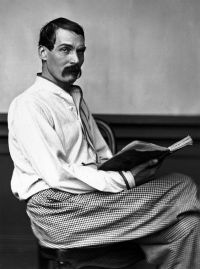
Sir Richard Francis Burton

Sir Richard Francis Burton

Summary

Portrait of Sir Richard Francis Burton Sir Richard Francis Burton Zanzibar; city, island, and coast… (1872)

It is a mere roadstead, without other protection against the long sweep and swell of the Indian Ocean than a few scattered ‘washes,’ and a coralline islet. The settlement lies at some distance from the shore, deep-bosomed in trees, behind a tall screen of verdant mangrove; only the nodding cocoa, sure indicator of man’s presence in East Africa, towering high over the plebeian underwood, betrays its position to the mariner. The large village of wattle and dab huts is inhabited, like Mtuapa and Takaungu, by remnants of the proud Mazrui irreconcileables, still self-exiled from Mombasah.
Source: Gutenberg

Portrait of Sir Richard Francis Burton Sir Richard Francis Burton Zanzibar; city, island, and coast… (1872)

Every blessing save that of beauty has now passed away from it, and instead of ‘cet éternel nuage de fumée qui dort sur les toits, et le bourdonnement lointain de la ruche immense,’ we see the wild ‘smokes’ of the tropical coast, and we hear the scream of the seamew harshly invading the silence and solitude of a city in ruins.
Returning to Kivinjya, we consulted the Wali and the principal inhabitants about the feasibility of a march upon the Nyassa or Southern Lake—here, as at Zanzibar, not a soul confounded it with the Tanganyika.
Source: Gutenberg

Portrait of Sir Richard Francis Burton Sir Richard Francis Burton Zanzibar; city, island, and coast… (1872)

The Banyans have a proverb that a Baloch, a Brahman, and a buck-goat eat the trees to which they are tied. Sudden and sharp in quarrel, they draw their daggers upon the minutest provocation; they have no mitigation nor remorse of voice, and they pray in the proportion of one to a dozen. Africa is to them what the Caucasus is to the Russians, Kabylie to the French, and Sind to the English soldier. All look forward to ‘Hindostan—bagh o bostan,’ India the flower-garden; but the Arabs have a canny proverb inporting that the fool who falleth into the fire rarely falleth out of it.
Source: Gutenberg

Get perspective with Kwize: daily news enlightened by great literature