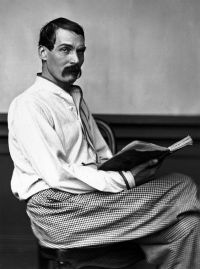
Sir Richard Francis Burton

Sir Richard Francis Burton

Summary

Portrait of Sir Richard Francis Burton Sir Richard Francis Burton Zanzibar; city, island, and coast… (1872)

When his mind is set upon an acquisition, he becomes a monomaniac, like that child-man the savage. His nonchalance, carelessness, and improvidence pass all bounds. He will light his pipe under a dozen leaky kegs of gunpowder; ‘he will set a house on fire, as it were, to roast his eggs;’ he will wreck his ship because anchoring her to the beach saves trouble in loading; he might make his coast a mine of wealth, but he will not work till hunger compels him, and his pure insouciance has allowed his valuable commerce to be wrested from him by Europeans, Hindus, and Arabs.
Source: Gutenberg

Portrait of Sir Richard Francis Burton Sir Richard Francis Burton Zanzibar; city, island, and coast… (1872)

Corpses float at times upon the heavy water; the shore is a cess-pool, and the younger blacks of both sexes disport themselves in an absence of costume which would startle even Margate. Round-barrelled bulls, the saints of the Banyans, and therefore called by us ‘Brahmani,’ push and butt, by way of excitement, the gangs of serviles who carry huge sacks of cowries, and pile high their hides and logwood. Others wash and scrape ivory, which suggested to a young traveller the idea that the precious bone, here so plentiful, is swept up by the sea. At night the front often flares as if on fire.
Source: Gutenberg

Portrait of Sir Richard Francis Burton Sir Richard Francis Burton Zanzibar; city, island, and coast… (1872)

Zanzibar, however, must be seen on one of her own fine days: like Fernando Po and Rio de Janeiro, the beauty can look ‘ugly’ enough when she pleases.
As we drew nearer and vision became more distinct, we found as many questions for the pilot as did Vasco da Gama of old. Those prim plantations which, from the offing, resembled Italian avenues of oranges, the tea-gardens of China, the vines of romantic Provence, the coffee plantations of the Brazil, or the orange-yards of Paraguay, were the celebrated clove-grounds, and the largest, streaking the central uplands, were crown property.
Source: Gutenberg

Get perspective with Kwize: daily news enlightened by great literature