Summary

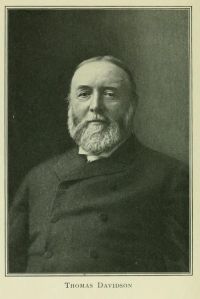
Portrait of Thomas Davidson Thomas Davidson Aristotle and Ancient Educational Ideals

Man is so far from being the measure of all things, that there is in all things a measure to which he must conform, if he is not to sink into error. This measure, this system of whole truths, implying an eternal mind to which it is present, and by which it is manifested in the world, is just what man arrives at, if he will but think out his thoughts in their completeness. In doing so, he at once learns the laws by which the universe is governed and finds a guide and sanction for his own conduct—a sanction no longer external and imposed by the State, but internal and imposed by the mind.
Source: Gutenberg

Portrait of Thomas Davidson Thomas Davidson Aristotle and Ancient Educational Ideals

But no sooner did the growth of commerce throw wealth into the hands of a class that owned no land, and was not above engaging in industry, than this class began to claim a share in political power. There were now two wealthy classes, standing opposed to each other, a proud, conservative one, with "old wealth and worth," and a vain, radical one, with new wealth and wants, both bidding for the favor of the class that had little wealth, little worth, and many wants, and thus making it feel its importance. Such is the origin of Athenian democracy. It is the child of trade and productive industry.
Source: Gutenberg

Portrait of Thomas Davidson Thomas Davidson Aristotle and Ancient Educational Ideals

We must be careful, in our study of Greek life and education, not to confound play and recreation, which are for the sake of work, with the free enjoyment of life, which is an end in itself, and to which all work is but a means. "Enjoyment is the end." We shall see, as we proceed, to what momentous results this distinction leads, how it governs not only all education but all the institutions of life, and how it finally contributes to break up the whole civilization which it determines.
Source: Gutenberg

Get perspective with Kwize: daily news enlightened by great literature