Summary

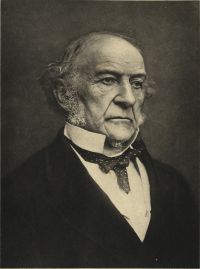
Portrait of W. E. Gladstone W. E. Gladstone Studies on Homer and the Homeric Age…

If it be a phrase simply serving the purpose, as an epithet would, of denoting the great political position of Agamemnon, how can its force be more utterly shattered than by bestowing it not only upon Eumelus, who does nothing except drive a chariot, but upon Euphetes, who is mentioned but once in the poems of Homer, without any epithet or circumstance whatever except this to distinguish him, and who is named nowhere else at all? If it describes a ruler as supreme among rulers, why is it thus debasingly, as well as loosely, applied?
Source: Gutenberg

Portrait of W. E. Gladstone W. E. Gladstone Studies on Homer and the Homeric Age…

It is now time that we should recognise the truth, that they constitute a vast depository of knowledge upon subjects of deep interest, and of boundless variety; and that this is a knowledge, too, which can be had from them alone. It was the Greek mind transferred, without doubt, in some part through Italy, but yet only transferred, and still Greek both in origin and in much of its essence, in which was shaped and tempered the original mould of the modern European civilization. I speak now of civilization as a thing distinct from religion, but destined to combine and coalesce with it.
Source: Gutenberg

Portrait of W. E. Gladstone W. E. Gladstone Studies on Homer and the Homeric Age…

The innumerable forms of refined and delicate coincidence in names and facts, in the use of epithets, the notes of character, the turn of speeches and phrases, and the like, are so many rills of evidence, which combine into a stream of resistless force, in favour of that text which has been found so admirably, as a mirror, to reflect the image and the mind of Homer, and which, like a mirror, could not have reflected it truly unless it had itself been true.
Source: Gutenberg

Get perspective with Kwize: daily news enlightened by great literature