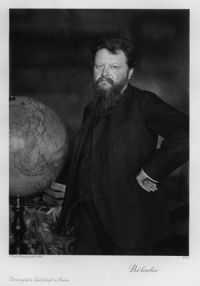
Wilhelm Bölsche

Wilhelm Bölsche

Haeckel (1906)

Summary

Portrait of Wilhelm Bölsche Wilhelm Bölsche,  Haeckel (1906)

“ There is the brain, where the thoughts crowd together. There is the cell, that builds up the whole body, the cell that so closely resembles the lowest of all living things, not yet distinct enough to be either animal or plant. Here are the forms that he successively assumes in his mother’s body, before he is born—forms that can hardly be distinguished from those of the animal at the same stage of development. From almost divine heights he has sunk down to the beast, to the primitive cell—nay, deeper still, to the elementary, force-impelled matter of the universe. ”
Source: Gutenberg

Portrait of Wilhelm Bölsche Wilhelm Bölsche,  Haeckel (1906)

“ The whole magic of his personal influence sprang from these depths. By profession he was a physiologist, an exact scientist. Never did he swerve a hair’s breadth from the iron laws of research. But beneath it all was a suppressed glow of fervour. Every one who understood him, every one who was a true pupil of his, learned it by a kind of hypnotism. Externally he was all for laborious investigation, whether in dissecting a 67star-fish for you or classifying fishes—though he would have a full sense of your ardent longing for an inner trust in life and a philosophy of life. ”
Source: Gutenberg

Portrait of Wilhelm Bölsche Wilhelm Bölsche,  Haeckel (1906)

“ Schleiden had branded the theory of man as a cell-state, the conception of man as, not an absolute, but a federal unity, as materialism. But this conception is not a philosophical theory at all; it is a fact. It is a piece of scientific truth, like the law of gravitation. He recurred to the old and often-quoted definition: the kind of research that brings such facts to light has nothing whatever to do with philosophy. On the other hand, “materialism,” in so far as it expresses a general theory of the world, is a philosophy. ”
Source: Gutenberg

Get perspective with Kwize: daily news enlightened by great literature