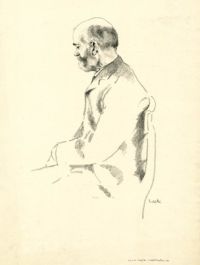
William Richard Morfill

William Richard Morfill

Summary

Portrait of William Richard Morfill William Richard Morfill 1911 Encyclopædia Britannica (1911)

We have a faithful picture of the Russia of the time, with all its barbarisms and ignorance. We see the unbounded authority of the husband in his own household: he may inflict personal chastisement upon his wife; and her chief duty lies in ministering to his wants. To the reign of Ivan the Terrible must also be assigned the Chetii-Minei or “Book of Monthly Readings,” containing extracts from the Greek fathers, arranged for every day of the week.
Source: Wikisource

Portrait of William Richard Morfill William Richard Morfill 1911 Encyclopædia Britannica (1911)

In the second cycle the legends group themselves round the celebrated Prince Vladimir of Kiev. The chief hero is Ilya Muromets, who performs prodigies of valour, and is of gigantic stature and superhuman strength. The cycle of Novgorod deals with the stories of Vasilii Buslaevich and Sadko, the rich merchant. The fourth cycle deals with the autocracy; already Moscow has become the capital of the future empire. We are told of the taking of Kazan, of the conquest of Siberia by Yermak, of Ivan the Terrible and his confidant Maliuta Skurlatovich.
Source: Wikisource

Portrait of William Richard Morfill William Richard Morfill 1911 Encyclopædia Britannica (1911)

Russian writers have not often devoted themselves to the political and social conditions of other countries, but an exception must be made in the case of the books by Professor Vinogradov, formerly of Moscow, notably his Investigations into the Social History of England in the Middle Ages (1887) . The learned author, who was called to Oxford as Corpus professor of jurisprudence, also prepared an edition of this work for the English public. In fiction no new writers appeared of equal calibre to Gogol, Turgeniev, Dostoievskiy and Tolstoy.
Source: Wikisource

Get perspective with Kwize: daily news enlightened by great literature