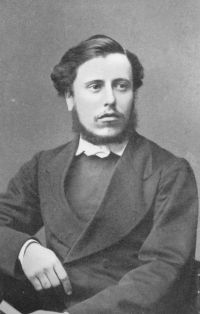
William Robertson Smith

William Robertson Smith

Summary

Portrait of William Robertson Smith William Robertson Smith Encyclopædia Britannica, Ninth Edition (1888)

A temple is not a meeting-place for worshippers; for many ancient temples were open only to priests, and as a general rule the altar, which was the true place of worship, stood not within the house but before the door. The temple is the dwelling-house of the deity to which it is consecrated, whose presence is marked by a statue or other sacred symbol; and in it his sacred treasures, the gifts and tribute of his worshippers, are kept, under the charge of his attendants or priests. Again, a temple implies a sanctuary; but a sanctuary or holy spot does not necessarily contain a temple.
Source: Wikisource

Portrait of William Robertson Smith William Robertson Smith Encyclopædia Britannica, Ninth Edition (1878)

To tradition, again, we owe the still powerful prejudice in favour of an allegorical interpretation, that is, of the view that from verse to verse the Song sets forth the history of a spiritual and not merely of an earthly love. To apply such an exegesis to Canticles is to violate one of the first principles of reasonable interpretation. True allegories are never without internal marks of their allegorical design. The language of symbol is not so perfect that a long chain of spiritual ideas can be developed without the use of a single spiritual word or phrase
Source: Wikisource

Portrait of William Robertson Smith William Robertson Smith Encyclopædia Britannica, Ninth Edition (1878)

It is a complete scene, but not a complete poem, and if it is not a fragment, we must expect to find the denouement at the close of the book. Now, at viii. 5, a female figure advances leaning upon her beloved, with whom she claims inseparable union, " for love is strong as death, its passion inflexible as the grave, its fire a divine flame which no waters can quench or floods drown.
Source: Wikisource

Get perspective with Kwize: daily news enlightened by great literature