“ All he had loved, and moulded into thought From shape and hue and odour and sweet sound. Lamented Adonais. Morning sought Her eastern watch-tower, and her hair unbound, Wet with the tears which should adorn the ground, 5 Dimmed the aerial eyes that kindle day; Afar the melancholy Thunder moaned, Pale Ocean in unquiet slumber lay, And the wild Winds flew round, sobbing in their dismay. ”
Adonais
Definition and stakes
Adonais, a literary concept originating in elegiac poetry, represents the lamentation of a departed figure through symbolic and natural imagery. Central to this theme is Percy Bysshe Shelley’s Adonais, which depicts the death of a young poet as a cosmic occurrence, merging sorrow with transcendence—nature itself mourns the loss, yet the spirit of Adonais unites with the eternal.
Other authors, like Barnette Miller, criticize its elaborate style, while others, such as Various, portray Adonais as a bold challenger to societal limitations. The theme thus weaves personal grief, philosophical contemplation, and literary tribute, illustrating how mortality and immortality are continually reinterpreted through artistic expression.
Quotes about “Adonais”
“ Pleasure, heart-struck at the death of Adonais, has abrogated her own nature, and has become blinded with tears; her eyes can therefore serve no longer to guide her steps. Her smile too is dying, but not yet dead ”
“ This murderer, a 'nameless worm,' was alone callous to the prelude of the forthcoming song. (37) Let him live on in remorse and self-contempt. (38) Neither should we weep that Adonais has 'fled far from these carrion-kites that scream below.' His spirit flows back to its fountain, a portion of the Eternal. (39) Indeed, he is not dead nor sleeping, but 'has awakened from the dream of life.' Not he decays, but we. (41) Let not us, nor the powers of Nature, mourn for Adonais. (42) He is made one with Nature. ”
Various, Graham's Magazine Vol XXXIII No…
“ Those who loved the stripling grieved to see him waste the spring-time of life in thus aimlessly loitering by the way-side; while the old men and sages would fain have taken from him his ill-used freedom, and shut him up in the prison-house where they bestowed their madmen, lest his example should corrupt the youth of the city.But for all this Adonais cared little. In vain they showed him the craggy path which traversed the hill of Fame; in vain they set him in the foul and miry roads which led to the temple of Mammon. ”
“ She reproached Adonais for having, though defenceless, dared the dragon in his den. Had he waited till the day of his maturity, 'the monsters of life's waste' would have fled from him, as (28) the wolves, ravens, and vultures had fled from, and fawned upon, 'the Pythian of the age.' (30) Then came the Mountain Shepherds, bewailing Adonais: the Pilgrim of Eternity, the Lyrist of lerne, and (31) among others, one frail form, a pard-like spirit. (34) Urania asked the name of this last Shepherd: he then made bare his branded and ensanguined brow, which was like Cain's or Christ's. ”
“ These Dreams were in fact the very thoughts of Adonais, as conveyed in his poems. He being dead, they cannot assume new forms of beauty in any future poems, and cannot be thus diffused from mind to mind, but they remain mourning round their deceased herdsman, or master. It is possible that this image of a flock and a herdsman is consequent upon the phrase in the Elegy of Moschus for Bion—'Bion the herdsman is dead' (p. 65) .Stanza 10, 1. 2. And fans him with her moonlight wings. ”
“ I weep for Adonais—he is dead! Oh weep for Adonais, though our tears Thaw not the frost which binds so dear a head! ”
Barnette Miller, Leigh Hunt's Relations with Byron…
“ Adonais is fifty-five stanzas of “unintelligible stuff” made up of every possible epithet that the poet has been able to “conglomerate in his piracy through the Lexicon.” The sense has been wholly subordinated to the rhymes. The author is a “glutton of names and colours” and has accomplished no more than might be done on such subjects as Mother Goose, Waterloo or Tom Thumb. Two cruel and loathsome parodies follow: Wouther the city marshal broke his leg and an Elegy on My Tom Cat, which, it is claimed, are less nonsensical, verbose and inflated than Adonais. ”
“ May 'the curse of Cain light on his head who pierced thy innocent breast,' and scared away its angel soul! (20) Can it be that the soul alone dies, when nothing else is annihilated? (22) Misery aroused Urania: urged by Dreams and Echoes, she sprang up, and (23) sought the death-chamber of Adonais, (24) enduring much suffering from 'barbèd tongues, and thoughts more sharp than they.' (25) As she arrived, Death was shamed for a moment, and Adonais breathed again: but immediately afterwards 'Death rose and smiled, and met her vain caress.' (26) Urania would fain have died along with Adonais ”
“ The part assigned to Urania in Shelley's Elegy is very closely modelled upon the part assigned to Aphrodite in the Elegy of Bion upon Adonis (see the section in this volume, Bion and Moschus) . What Aphrodite Cypris does in the Adonis, that Urania does in the Adonais. The resemblances are exceedingly close, in substance and in detail: the divergences are only such as the altered conditions naturally dictate. The Cyprian Aphrodite is the bride of Adonis, and as such she bewails him: the Uranian Aphrodite is the mother of Adonais, and she laments him accordingly. ”
 Percy Bysshe Shelley,
The Complete Poetical Works of Percy Bysshe Shelley…
Percy Bysshe Shelley,
The Complete Poetical Works of Percy Bysshe Shelley…
“ Oh, weep for Adonais—he is dead! Wake, melancholy Mother, wake and weep! _20 Yet wherefore? Quench within their burning bed Thy fiery tears, and let thy loud heart keep Like his, a mute and uncomplaining sleep; For he is gone, where all things wise and fair Descend;—oh, dream not that the amorous Deep _25 Will yet restore him to the vital air; Death feeds on his mute voice, and laughs at our despair. ”
Raymond MacDonald Alden, English Verse: Specimens Illustrating its Principles and History
“ Professor Corson (Primer of English Verse, p. 112) quotes Mr. Todhunter as saying: "Compare the impetuous rapidity and pale intensity of Shelley's verse with the lulling harmony, the lingering cadence, the voluptuous color of Spenser's, or with the grandiose majesty of Byron's.... In Adonais, indeed, a poem on which he bestowed much labor, he handles the stanza in a masterly manner, and endows it with an individual music beautiful and new." "Courage!" ”
“ They remain indefinite both to the poet and to the reader. The conclusion of the stanza, worded with great beauty and delicacy, amounts substantially to saying—'Take your last look of the dead Adonais while he may still seem to the eye to be rather sleeping than dead.'1. 7. He lies as if in dewy sleep he lay. See Bion (p. 64) , 'Beautiful in death, as one that hath fallen on sleep.' The term 'dewy sleep' means probably 'sleep which refreshes the body as nightly dew refreshes the fields.' This phrase is followed by the kindred expression 'liquid rest.'Stanza 8, 1. 3. ”
“ Bion (p. 64) simply says that 'Echo resounds, "Adonis dead!"' But Moschus (p. 65) , whom Shelley substantially follows, sets forth that 'Echo in the rocks laments that thou [Bion] art silent, and no more she mimics thy voice'; also, 'Echo, among the reeds, doth still feed upon thy songs.' It will be observed that in this stanza Echo is a single personage—the Nymph known to mythological fable: but in stanza 2 we had various 'Echoes,' spirits of minor account, who, in the paradise of Urania, were occupied with the poems of Adonais. ”
“ Looking through the stanzas of Adonais, I find the following laxities of rhyming: Compeers, dares; anew, knew (this repetition of an identical syllable as if it were a rhyme is very frequent with Shelley, who evidently considered it to be permissible, and even right—and in this view he has plenty of support) : God; road; last, waste; taught, not; break, cheek (two instances) ; ground, moaned; both, youth; rise, arise; song, stung; steel, fell; light, delight; part, depart; wert, heart; wrong, tongue; brow, so; moan, one; crown, tone; song, unstrung; knife, grief; mourn, burn ”
“ As Death tended towards 'annihilation,' so Adonais tended towards revival.1. 7. 'Silent lightning.' This means, I suppose, lightning unaccompanied by thunder—summer lightning.Stanza 26, 1. 1. 'Stay yet awhile.' See Bion (p. 64) : 'Stay, Adonis! stay, dearest one!'1. 2, 'Kiss me, so long but as a kiss may live.' See as above:—— 'That I may kiss thee now for the last time— But for as long as one short kiss may live!'1. ”
“ And one upon his shafts, another on his bow, is treading, and one hath loosed the sandal of Adonis, and another hath broken his own feathered quiver, and one in a golden vessel bears water, and another laves the wound, and another, from behind him, with his wings is fanning Adonis.... Thou must again bewail him, again must weep for him another year.... He does not heed them [the Muses] ; not that he is doth to hear, but that the Maiden of Hades doth not let him go.'The next-ensuing passages come from the Elegy of Moschus for Bion:—'Ye flowers, now in sad clusters breathe yourselves away. ”
“ To see the sun shining on its bright grass, fresh, when we visited it, with the autumnal dews, and hear the whispering of the wind among the leaves of the trees which have overgrown the tomb of Cestius, and the soil which is stirring in the sun-warm earth, and to mark the tombs, mostly of women and young people who were buried there, one might, if one were to die, desire the sleep they seem to sleep. ”
“ He has outsoared the shadow of our night. Envy and calumny and hate and pain, And that unrest which men miscall delight, Can touch him not and torture not again. From the contagion of the world's slow stain 5 He is secure; and now can never mourn A heart grown cold, a head grown grey in vain— Nor, when the spirit's self has ceased to burn, With sparkless ashes load an unlamented urn. ”
“ The splendours of the firmament of time May be eclipsed, but are extinguished not; Like stars to their appointed height they climb, And death is a low mist which cannot blot The brightness it may veil. When lofty thought 5 Lifts a young heart above its mortal lair, And love and life contend in it for what Shall be its earthly doom, the dead live there, And move like winds of light on dark and stormy air. ”
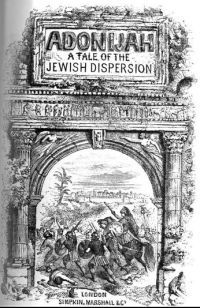 Jane Margaret Strickland,
Adonijah: A Tale of the Jewish Dispersion
Jane Margaret Strickland,
Adonijah: A Tale of the Jewish Dispersion
“ Sometimes indeed a light word or bold look from those around her flushed her fair face with the crimson glow of wounded modesty, and her eyes sparkled till tears of shame dimmed them, and again she looked like a sculptured personification of purity and sorrow. The deep sympathy of Adonijah, although unexpressed by words or manner, was conveyed by looks whose language needed no other eloquence. She felt that one being among the heartless throng regarded her with interest, with compassion, and with love. ”
Jane Margaret Strickland,
Adonijah: A Tale of the Jewish Dispersion
“ In this second glance Adonijah recognised the master of the Roman world.“Is this all thy sum of care, and darest thou claim from Nero the supremacy of sorrow?” continued the prince. “Slave, thou art happier in thy chains than Cæsar on his throne! Dost thou see the dagger of the assassin lurking under the garments of every person who approaches thee? Art thou loathed by those who flatter thee, and secretly cursed by those who bend the knee before thee? ”
Jane Margaret Strickland,
Adonijah: A Tale of the Jewish Dispersion
“ Surprised, and not immediately recognising the emperor, who was still attired as a comedian, Adonijah unveiled his convulsed features and replied in the same tongue, one which was familiar to him.“Why troublest thou me with questions? I was free—I am a slave. I had kindred ties—I am alone among the thousands of Israel. I had a God, and he has forsaken me. Whose sorrow can be compared to my sorrow? who among the children of men can be compared in misery to me?” ”

“ Adone went close up to him. "Opposition to what? What is it you are doing here?" "We are not your servants," said the gentleman with impatience. "Do not attempt any brawling I advise you; it will tell against you and cannot serve you in any way." "The soil and the water are mine, and you meddle with them," said Adone. "If you were honest men you would not be ashamed of what you do, and would declare your errand. Brawling is not in my habit; but I will drive my oxen over you. The land and the waters are mine." ”
Jane Margaret Strickland,
Adonijah: A Tale of the Jewish Dispersion
“ Superstitious feelings crept over the bold spirit of Adonijah; he pronounced the name of God and looked once more upon the countenance of the emperor. The wild expression of derision was gone, despair alone pervaded it. The features, the brow, were beautiful, but it was beauty stained with sin; the lineaments were youthful, though marked with an age of crime; the sneer on the lip bespoke scorn of himself and all mankind, but the eye was cruel, and expressed lawless power rather than princely majesty ”
“ He had himself been in early manhood passionately ambitious; he was only a priest, but of priests are made the Gregorio, the Bonifazio, the Leone of the Papal throne; to the dreams of a seminarist nothing is impossible. But Adone had no such dreams; he was as satisfied with his lot as any young steer which wants nothing more than the fair, fresh fields of its birth. But one day as he was sitting with the boy, then fifteen years old, on the south bank of the Edera, the spirit moved him and he spake. ”
Jane Margaret Strickland,
Adonijah: A Tale of the Jewish Dispersion
“ In this state the affianced bride of Nymphidius Sabinus was borne into her brother’s house. In this sad condition Adonijah beheld the unhappy victim of his bigotry—her to whom he had professed the most passionate love. As the females of the household removed her veil to give her air, her bright ringlets, those ringlets lately hidden beneath the head-dress of the vestal, fell round her face, giving to its paleness a more death-like character. Her whole figure, indeed, enveloped in the white robe of the neophyte, resembled more a statue of Parian marble than living flesh. ”
Jane Margaret Strickland,
Adonijah: A Tale of the Jewish Dispersion
“ Adonijah indeed, in recognising the war-wasted countenance of Ithamar, scarcely remembered that they had once been foes. Years of bondage and exile had nearly obliterated all traces of former hatred from his breast. No rival, but an old companion in arms appeared to stand before him—one who had fought for the same sacred cause, and was united with him in the same sad brotherhood of sorrow. He lowered the point of his weapon, saying as he did so, “Ithamar, in me you behold no hostile opponent; my hatred has perished with my country: I know no enemies but Romans.” ”
Jane Margaret Strickland,
Adonijah: A Tale of the Jewish Dispersion
“ If the first impression made by the fair heathen priestess had inspired Adonijah with a passion he had never felt for his own more enlightened countrywomen, her gentleness and domestic qualities deepened it into the most devoted love. It is in her own home that woman is best known, because within that little circle her tenderest affections expand, and, like the sunbeams, gladden and bless all within their influence. Sovereign lady of the household, no haughty gesture nor harsh language ever enforced her authority, and the meanest slave revered in her a benefactress. ”
Jane Margaret Strickland,
Adonijah: A Tale of the Jewish Dispersion
“ The delicious coolness of this retreat restored the drooping frame of the little Lucius to health, who had long pined for the pure air of the country during his father’s abode in Rome. The affection Adonijah felt for this charming child partook largely of the paternal character, and he loved to trace in his open brow and sweet pensive smile the looks of those who were then only ashes. He taught the babe to worship the great Being he adored, and to repeat many a sweet psalm and prayer in that tongue become as familiar to his infant lips as his own native Latin. ”
Jane Margaret Strickland,
Adonijah: A Tale of the Jewish Dispersion
“ His early excesses, his companionship with Nero, the murder of his brother, the forced marriage of his sister, the snare he had laid for Adonijah, for the man who had preserved him from the dagger of Tigranes, the death of his own child, of which he considered himself the cause,—all crowded upon his soul with the dreadful force of truth. Tears streamed from his eyes, tears the bitterest that ever wrung the heart of guilt. ”
Jane Margaret Strickland,
Adonijah: A Tale of the Jewish Dispersion
“ The Gentiles, plunged in dark idolatry, are ignorant of this great truth, and therefore, shrinking from the trials of adversity, to avoid the lesser evil rush upon the greater. Life for me has no charms, though I endure its burden. Seest thou yonder tree, over which the storm hath lately passed? In its days of strength and beauty it was a fitting emblem of Adonijah, so now in its ruin you may behold a lively image of his desolation. Like him it still exists, though like him it will never renew its branches, or fulfil the glorious promise of its youth. ”
