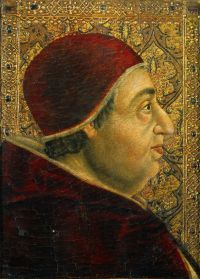
Alfonso VI of León

Definition and stakes

The historians' history of the world in twenty-five volumes…

After a long reign which succeeding generations have ever borne in mind as a period of glory, justice, and general prosperity, Alfonso VI died in 1109 of a broken heart at the defeat of Ucles and the loss of his only son. His daughter Urraca, queen of Leon and Castile, who governed the country during her son’s minority, espoused Alfonso I, king of Aragon, as her second husband. But instead of strengthening the unity and power of Christian Spain, this alliance led to furious civil wars which served to strengthen and prolong Moslem dominion.
Source: Gutenberg

The historians' history of the world in twenty-five volumes…

As his children were not of age and the Navarrese refused to acknowledge the fratricide as their sovereign, the two kings Alfonso VI of Castile and Sancho Ramirez of Aragon marched into the neighbour kingdom, put Raymond to flight and divided the country between them; the country as far as the Ebro being united to Aragon, and Rioja, with Najera and Calahorra and the Basque provinces of Alava, Guipuzcoa, and Biscay falling to the share of Alfonso VI of Castile and Leon.
Source: Gutenberg

The historians' history of the world in twenty-five volumes…

In his last will, Alfonso named his two daughters—for the kingdom had long ceased to be elective—joint heiresses of his states. Fortunately for Spain, the majority of the Leonnese took a sounder view of their interests than Alfonso. Nobles, clergy, and people were too numerous in favour of the king of Castile, to leave those princesses the remotest chance of success. No sooner did that prince hear how powerful a party supported his just pretensions, than he hastened from Andalusia into Leon.
Source: Gutenberg

Get perspective with Kwize: daily news enlightened by great literature