Brazil wood

Definition and stakes

George D. Armstrong,  Cyclopedia of Painting (1908)

“ Boil 1 pound of Brazil-wood in 1 gallon of water for three hours or more, add 1 ounce of pearlash, and apply it to the wood whilst hot, then brush over it a solution made of 2 ounces of alum in 1 quart of water. A solution of dragon's-blood in spirits-of-wine makes a very good stain, as already mentioned. The Brazil-wood is cut from a tree about twenty feet high, with prickly branches and yellow flowers, the decoction yields, in dyeing, rose-color, red, and yellow, according to the mordant used. ”

Source: Wikisource

1911 Encyclopædia Britannica (1911)

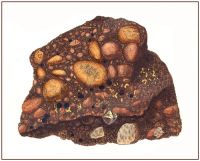
“ There are several woods of the kind, commercially distinguished as Brazil wood, Nicaragua or Peach wood, Pernambuco wood and Lima wood, each of which has a different commercial value, although the tinctorial principle they yield is similar. Commercial Brazil wood is imported for the use of dyers in billets of large size, and is a dense compact wood of a reddish brown colour, rather bright when freshly cut, but becoming dull on exposure. The colouring-matter of Brazil wood, brazilin, C16H14O5, crystallizes with 11/2 H2O, and is freely soluble in water ”
Source: Wikisource

Portrait of Samuel de Champlain Samuel de Champlain,  Narrative of a Voyage to the West Indies and Mexico in the Years 1599-1602

“ The first is the Brazil wood, or Brésillet, of Pernambuco, a large tree growing naturally in South America, used in commerce for red dye. The second is indigenous in India, where it is used for the same purpose, and known in the trade as sappan wood; in France, "Brésellet des Indes."
The origin of the name "Brazil," or "Brésil," for this wood, was long a moot point, whether the country took its name from the tree, or the tree from the country. Many early writers (and some modern) have thought that it was derived from the country.
”
Source: Gutenberg

Get perspective with Kwize: daily news enlightened by great literature