“ To convert an army of a few hundred thousands into a mighty machine of millions—what achievement! And this, in a few months. To clothe, equip, and supply these men with munitions—an even greater task! Yet this England did; and French military critics were amazed at an exploit unequalled in the world's history. The little band of men who fought so gallantly at Mons, and whose opportune arrival helped to turn the first tide of invasion, have grown and increased to the gigantic British Army of to-day. Nothing delighted the French as much as the establishment of Conscription in England. ”
British military
Definition and stakes
The theme of “British military” has been addressed by authors such as Richard Cannon, Charles Cooper King, W. H. Maxwell, Francis Dodd and Arthur Conan Doyle. It is often associated with terms like army, war, England, infantry and gallantry.
Quotes about “British military”
 Spenser Wilkinson,
Lessons of the War: Being Comments from Week to Week to the Relief of Ladysmith
Spenser Wilkinson,
Lessons of the War: Being Comments from Week to Week to the Relief of Ladysmith
“ The idea seems to be spreading that this war must lead to a thorough overhauling and recasting of the British military organisation. But if you are to make a bigger army, an army better suited to the times and to the needs of the Nation, you must begin by getting a competent army-creating instrument. ”
James M. Campbell, A British army, as it was, - is… (1840)
“ I hope, however, that Great Britain will never become so humbled, as to require salvation from naval and military patriotism; but I boldly assert, and without fear of contradiction, that no where on earth, amongst men, is this virtue to be found so pure as in the hearts of the officers of our navy and army. ”
Charles Cooper King, The Story of the British Army
“ In his last despatch from the Nile, in June 1885, he thus refers to the lads who had undergone the severe strain of the campaign, and with comparatively so little loss. “It is a source of great pride to me as a soldier, and of satisfaction as a British subject, that upon each fresh occasion when I am brought in contact with Her Majesty’s troops in the field, I find the army more efficient as a military machine than it was the last time I was associated with it on active service. ”
J. Ross, A History of the Coldstream Guards…
“ But the influence it commands, by strengthening the ties that bind the military and the civil elements, by rendering the regular army popular, and by therefore facilitating the recruitment of a good class of man, is well known; while the self-sacrifice of many who devote their leisure to martial exercises, without prospect of reward, is creditable to the British character, and tends to 303spread a wider interest in military affairs than was formerly the case. ”
Hubert Foster, Organization: How Armies are Formed for War
“ A study of the present British war organization,xix described in some detail in Part II., will show that it embodies a large number of the changes suggested by recent wars, and demanded by the trend of modern military thought. The British Army is the latest to be reorganized, and the opportunity has been taken, with no less courage than wisdom, to adopt in every Branch all changes tending to fit it better for the fighting of the immediate future, as far as this can be forecast. ”
W. H. Maxwell, The Victories of Wellington and the British Armies
“ Is it not inconceivable, that Britain should have consigned her armies to the leading of antiquated tacticians, bigoted in old-world notions, and who would scarcely venture beyond a second bridge, without spending half the day in reconnoitring?78 But such things were—and the energies of the first military people in the world were paralyzed for half a century, by commands being entrusted to men, who, in cases of ordinary embarrassment, would have been found incompetent to extricate a regiment from a difficulty. ”
Albert Venn Dicey, Letters to a friend on votes for women… (1909)
“ No soldier, and very few civilians, can assert with confidence that our present army is sufficient for our defence. It is uncertain, as we all now know, whether our navy can of itself guarantee the United Kingdom against invasion. On the Englishmen who, civilians though they remain, must, as high authorities tell us, receive military training, will depend the maintenance of England's independence, and the existence of the British Empire. ”
W. H. Maxwell, The Victories of Wellington and the British Armies
“ Every candid and unprejudiced officer will admit that Britain had never a navy before, to be compared with that which she now possesses—and on careful examination, it will be found that her military establishment is still more perfect. ”
Charles Cooper King, The Story of the British Army
“ THE BRITISH ARMY CHAPTER I THE ARMY OF THE PEOPLE—TO 1100 All nations have passed, more or less, through the same stages in the up-growth of that military system which is as essential to the political security of the mass as the formation of a police force is necessary for the protection of the individual in civil life. From the outset, the history of human existence has been one of combat. ”
W. H. Maxwell, The Victories of Wellington and the British Armies
“ The military power of France was organized anew. Commissioners, specially employed, enforced the operations of Napoleon’s decrees in every department of the kingdom. The Imperial Guard was re-established—the cavalry increased and remounted—that powerful arm, the artillery, by which half the victories of the French army had been achieved, was411 enlarged and improved—and, in a time inconceivably short, a most splendid corps d’armée, perfect in every department, was ready for the field. ”
Anonymous, Regimental Nicknames and Traditions of the British Army
“ The traditions of the British Army stretch back over four centuries, during which it has been the acknowledged means of winning and building up the greatest Empire the world has ever known. The Army's deeds are a sealed book so far as the general public are concerned, for military matters except in times of actual war have never been a popular subject, the great heroes of the battlefield being far less known to the British public than popular performers on the football field or pampered professional boxers. ”
James M. Campbell, A British army, as it was, - is… (1840)
“ The corps, as I may call it, to which these conveyances should belong, ought to consist of steady drivers, one for each car and pair of horses, (but he ought not upon any account to be allowed to ride) some non-commissioned officers and officers having certain military rank and authority. This useful body of men should be formed by enlistment in the United Kingdoms, and the horses either procured there, or in the country to become the seat of war; but the corps and its cars and equipments should accompany any military force whenever it was ordered to embark for service. ”
James M. Campbell, A British army, as it was, - is… (1840)
“ I hope, therefore, I may be allowed to observe, that it is much to be regretted, it has not struck Colonel Pasley, that a work coming from him, elucidating some of the subjects I have reluctantly ventured to touch upon, especially those connected with Russia, and a new boundary line for our North American territories, would be well received by statesmen, military men, and the country in general; all of whom must allow that an efficient and highly disciplined army and navy are now wanted by Great Britain, and that no time should be lost in acquiring them. ”
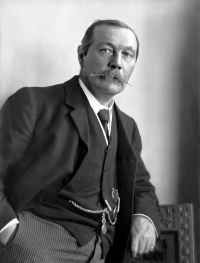 Arthur Conan Doyle,
The British Campaign in France and Flanders…
Arthur Conan Doyle,
The British Campaign in France and Flanders…
“ They were destined to show the absolute impossibility of such a task in the face of a steadfast unshaken enemy, supported by a tremendous artillery, but their story is a most glorious one, and many a great British victory contains no such record of tenacity and military virtue. ”
Various, The New York Times Current History of the European War…
“ All along the lines I have spoken to officers and men, and the actual truth is that the British Army is still unbroken, having retired in perfect order to good positions—the most marvelous feat ever accomplished in modern warfare. ”
Frederick Watson, The Story of the Highland Regiments
“ The British soldier is vigorous, well-fed, by nature both brave and intrepid, trained to the most rigorous discipline and admirably armed. The infantry resist the attacks of cavalry with great confidence, and when taken in flank or rear, British troops are less disconcerted than any European army. ”
“ Let us not deceive ourselves, sir. These are the implements of war and subjugation, the last arguments to which kings resort. I ask gentlemen, sir, what means this martial array, if its purpose be not to force us to submission? Can gentlemen assign any other possible motive for it? Has Great Britain any enemy in this quarter of the world to call for all this accumulation of navies and armies? No, sir, she has none. They are meant for us. They can be meant for no other. They are sent over to bind and rivet upon us those chains which the British ministry have been so long forging. ”
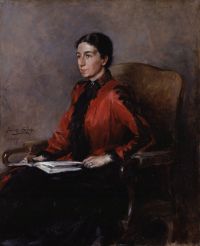 Mrs. Humphry Ward,
The War on All Fronts: England's Effort
Mrs. Humphry Ward,
The War on All Fronts: England's Effort
“ Remember first that every man, every horse, every round of ammunition, every article of clothing and equipment, all the guns and vehicles, and nearly all the food have to be brought across the English Channel to maintain and reinforce the ever-growing British Army, which holds now so important a share of the fighting line in France. ”
James M. Campbell, A British army, as it was, - is… (1840)
“ The second army, to be officered as our present militia, and to be embodied upon the same system, and managed and disciplined as the first, and styled either Militia, or the Army of Reserve, could be called out to serve in Great Britain or Ireland only, when the country, either from being at war, or in case of commotions, might require its services ”
Charles Cooper King, The Story of the British Army
“ The main “arm” in battle was the mailed cavalry, and infantry was long thought little of; but in England speedily grew up the steady and trustworthy bowmen, the foundation of that infantry which has carried the national flag to victory in every part of the world, and which had no counterpart in those days in foreign armies, such as France, where the footmen were, till much later, merely armed serfs or dependants, armed indifferently, and treated with contumely. In England it was otherwise. There were both greater freedom, and better, because more independent men. ”
A British officer, The Powers of Europe and Fall of Sebastopol
“ It has been doubted by military historians if any enemy have ever stood a charge with the bayonet, but here the bayonet was often the only weapon employed in conflicts of the most obstinate and deadly character. Not only did the English charge in vain, not only were desperate encounters between masses of men maintained with the bayonet alone, but they were obliged to resist bayonet to bayonet, with the Russian infantry again and again, as they charged the British with incredible fury and determination. ”
R. W. Campbell, John Brown: Confessions of a New Army Cadet
“ If I, your colonel, have the courage to come and tell you of my own deficiencies, surely you boys will have the pluck to do a little heart-searching. You must also study the Service as a whole, and not in parts. Believe me, the British Army is a proud and glorious institution. The traditions are high. Great men have come from our ranks. In this war our arms are belaurelled with chivalry. Ours is no mercenary host, no band of knaves or babe-assassins. We fight a good fight. ”
Charles Cooper King, The Story of the British Army
“ The British marched across France, and embarked for England and America. The Spanish and Portuguese armies retired to their respective territories, and the French armies dispersed over France. The now fully established standing army of Great Britain had, notwithstanding the indiscipline and violence that at times unfortunately characterised its fighting, earned a reputation which it has never lost. ”
Edmund Dane, The Battle of the Rivers
“ But to employ in the same space a force no greater than the British, considering the advantage of position given with modern arms to an army acting on the defensive on well-chosen ground, would have meant the annihilation of the German army section by section. ”
Baron Max Aitken Beaverbrook, Canada in Flanders, Volume II
“ To the British of all nations this singular tribute must be paid: that their infantry has never been engaged in any protracted war without a universal admission that it was the equal of any infantry in the world; and yet that it has never been afforded the supreme incentive to soldiers, that of fighting on their own soil, and for their own women and children at the moment and on the scene of their instant peril. ”
Richard Cannon, Historical record of the Eighty-seventh Regiment… (1853)
“ The share which the British army have had in producing those events, and the high character with which the army will quit this country, must be equally satisfactory to every individual belonging to it, as they are to the Commander of the Forces, and he trusts that the troops will continue the same good conduct to the last. ”
published by the National Geographic Society, The National Geographic Magazine…
“ Certainly the civilian, English or American, who visits the British front these days and who realizes that every man and every ounce of stores and every pound of equipment, and, indeed, the whole army and all it eats and wears and uses, and the weapons wherewith it fights, have been brought there after two railway journeys and one sea journey, involving at least four and possibly six changes and transshipments, becomes just a little tired when he hears the British accused of inefficiency. ”
Richard Cannon, Historical Record of the Fifth…
“ The conduct of the British Troops, their valour, and endurance, have shone conspicuously under great and trying difficulties; and their character has been established in Continental warfare by the irresistible spirit with which they have effected debarkations in spite of the most formidable opposition, and by the gallantry and steadiness with which they have maintained their advantages against superior numbers. ”
James M. Campbell, A British army, as it was, - is… (1840)
“ The British Army did not consist of the constrained conscripts of arbitrary power, but of citizens voluntarily in arms to defend their country, to obey and respect her laws at home, and to resist and repel, with their utmost energy, every effort of her foreign foes, &c. ”
American-Irish Historical Society, The journal of the American-Irish Historical Society…
“ Not more than twenty-five miles away was about to be enacted the tragedy to the British arms, in which a rude and untutored genius, commanding undisciplined woodmen half-naked and half-starved, was matched against an educated and accomplished officer in command of regular troops greater in number, well-fed, well-conditioned, and as thoroughly disciplined as any troops in the world. The beginning of the end of British authority over American soil was at hand. ”
 Mercy Otis Warren,
History of the Rise, Progress, and Termination of the American Revolution
(1805)
Mercy Otis Warren,
History of the Rise, Progress, and Termination of the American Revolution
(1805)
“ The British were indeed very far superior to the Americans in every respect necessary to military operations, except the revivified courage and resolution, the result of sudden success after despair. ”
Evelyn Charles Vivian, The British Army from Within
“ But the British Army, until the present war linked it on to the man in the street, was not a part of the nation, but a thing distinct from the nation; it was a profession apart, and none too enviable a profession, in the opinion of many, but something to be avoided by men in equivalent walks of civilian life. ”
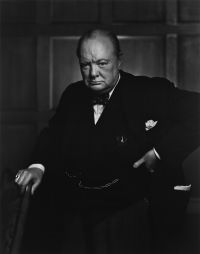 Winston Leonard Spencer Churchill,
We Shall Fight on the Beaches
(1940)
Winston Leonard Spencer Churchill,
We Shall Fight on the Beaches
(1940)
“ The whole root and core and brain of the British Army, on which and around which we were to build, and are to build, the great British Armies in the later years of the war, seemed about to perish upon the field or to be led into an ignominious and starving captivity. ”
Charles Cooper King, The Story of the British Army
“ In no other way, in fact, could Great Britain’s supremacy at sea be used with greater effect; and hence it is that in the battle-roll of many an English regiment are names of victories which are practically semi-naval affairs. In fact, the army has in its time been largely employed as marines, doing their twofold duty of in some cases acting as the ship’s guard, and at others that of a force to be landed for active service and re-embarked when their work was done. Hence, regiments, though on the strength of the army, were often lent to the navy for such duty. ”
Charles Cooper King, The Story of the British Army
“ It is curious to see, therefore, how the first voluntary national army, long embodied, produced an antagonism, among the mass of the people, to standing armies altogether, a feeling which lasts even until now in theory, if not in fact. ”
 Joseph Plumb Martin,
The Adventures Of A Revolutionary Soldier
(1830)
Joseph Plumb Martin,
The Adventures Of A Revolutionary Soldier
(1830)
“ We were immediately ordered from our old detachment and joined another, the whole composing a corps of about five hundred men. We instantly marched towards the enemy's right wing, which was in the orchard, and kept concealed from them as long as possible, by keeping behind the bushes. When we could no longer keep ourselves concealed, we marched into the open fields and formed our line. The British immediately formed and began to retreat to the main body of their army. ”
Related terms
Authors who wrote about “British military”
Richard CannonCharles Cooper KingW. H. MaxwellFrancis DoddArthur Conan DoyleJames WolfeMercy Otis WarrenFrederick Watson Benson John LossingJoseph Plumb Martin
 Archibald ForbesEdmund DaneVariousThomas Herbert RussellSpenser WilkinsonJ. RossWinston Leonard Spencer Churchill
 William Francis Patrick NapierBaron Max Aitken BeaverbrookIan Hay
Arthur Conan DoyleJames WolfeMercy Otis WarrenFrederick WatsonBenson John LossingJoseph Plumb MartinArchibald ForbesEdmund DaneVariousThomas Herbert RussellSpenser WilkinsonJ. RossWinston Leonard Spencer ChurchillWilliam Francis Patrick NapierBaron Max Aitken BeaverbrookIan Hay