“ The Casa Grande, a magnificent porticoed palace but one story high, covered the entire top of a desert rise. From its doorway one could see fifteen miles of yellow, rolling plain, and, beyond, the interminable ranges of bare mountains piled upon each other. Back of it lay the great corrals and stables, where the Tropa's evening fires already sent up myriad columns of yellow smoke. Below, in the hollow, more than a hundred peons' houses made a vast open square, where children and animals romped together, and the women kneeled at their eternal grinding of corn. ”
Casa Grande
Definition and stakes
The theme of “Casa Grande” has been addressed by authors such as Benjamin Moore Norman, Cosmos Mindeleff, Sir M. Digby Wyatt, Agnes C. Laut and Arthur Stringer. It is often associated with terms like house, architecture, mansion, town and garden.
Quotes about “Casa Grande”
Francis Rolt-Wheeler, The Boy With the U. S. Survey
“ The boys thought it rather a strain on the imagination to picture palaces in the dry square adobe walls, but as they walked up close to them, some lurking hint of former greatness became felt. The Casa Grande must have stood some four or five stories in height and the rooms were rarely less than twenty feet square, so that the idea was given not only of size but also of extreme age, this being due in part, of course, to the softness of the material of which they were built. ”
“ The walls of the Casa Grande are heavy and massive, ranging in thickness from 41⁄2 to 13⁄4 feet. To save work and to reduce weight on the foundation, the Indians narrowed the walls as they built them up. 7 The outside surface bows inward as the wall rises. The inside surface, however, is nearly vertical. ”
 Gertrude Franklin Horn Atherton,
The Doomswoman: An Historical Romance of Old California
Gertrude Franklin Horn Atherton,
The Doomswoman: An Historical Romance of Old California
“ X. Casa Grande, [A] the mansion of the Iturbi y Moncadas in Santa Barbara, stood at the right of the Presidio, facing the channel. A mile behind, under the shadow of the gaunt rocky hills curving about the valley, was the long white Mission, with its double towers, corridor of many arches, and sloping roof covered with red tiles. Between was the wild valley where cattle grazed among the trees and the massive bowlders. ”
 Christopher Morley,
Shandygaff
Christopher Morley,
Shandygaff
“ I spent a great deal of my time exploring the chief glory of the town, the Casa Grande, which stands on the colossal crag honeycombed underneath with the shafts and vaults of the cheese mine. There is nothing in the world more entrancing than to stand (with a vinaigrette at one's nose) on the ramp of the Casa, looking down over the ochre canal, listening to the hoarse shouts of the workmen as they toil with pick and shovel, laying bare some particularly rich lode of the pale, citron-coloured cheese which will some day make Strychnine a place of pélérinage for all the world. ”
Cosmos Mindeleff, Casa Grande Ruin
“ A fair degree of adaptability to purpose and environment is seen, indicating that the Casa Grande was one, and not the first, building of a series constructed by the people who erected it and by their ancestors, but the degree of skill exhibited and amount of ingenuity shown in overcoming difficulties do not compare with that found in many northern ruins. ”
 Arthur Stringer,
The Prairie Child
Arthur Stringer,
The Prairie Child
“ And I just as pointedly retorted that I’d never consent to the sale of Casa Grande. It’s not merely because it’s our one and only home. It’s more because of the little knoll where the four Manitoba maples have been set and the row of prairie-roses have been planted along the little iron fence, the little iron fence which twice a year I paint a virginal white, with my own hands. For that’s where my Pee-Wee sleeps, and that lonely little grave must never pass out of my care, to be forgotten and neglected and 70 tarnished with time. ”
 John T. Short,
The North Americans of Antiquity
(1879)
John T. Short,
The North Americans of Antiquity
(1879)
“ Stephens equal to those of any known era, even when tried by the severest rules of art. [508] At Zayi, one of the finest illustrations of this style of architecture is to be seen in what is known as the Casa Grande. The dimensions of the Casa Grande are as follows: lower story, 120 by 265 feet; the second story, 60 by 220 feet; and the third, resting on the summit platform of the mound, 18 by 150 feet; a stairway thirty-two feet wide furnishes a means of ascent to the third story on the front, while a narrow stairway leads to the second story at the rear. ”
Arthur Stringer,
The Prairie Wife
“ I went to the piano and pounded out Kennst Du Das Land with all my soul, and I imagine it did me good. It at least bombarded the silence out of Casa Grande. The noise of life is so far away from you on the prairie! It is not utterly silent, just that dreamy and disembodied sigh of wind and grass against which a human call targets like a leaden bullet against metal. It is almost worse than silence. ”
Gertrude Franklin Horn Atherton,
The Doomswoman: An Historical Romance of Old California
“ We took a long siesta that day, but hours before dark the populace was crowded in the court-yard under the booth which had been erected during the afternoon. After the early supper the guests of Casa Grande, and our neighbors of the town, filled the sala, the large bare rooms adjoining, and the corridors. The old people of both degrees seated themselves in rows against the wall, the fiddles scraped, the guitars twanged, the flutes cooed, and the dancing began. ”
Cosmos Mindeleff, Casa Grande Ruin
“ As these farming outlooks have been discussed at some length in another paper10 it is not necessary here to enlarge upon their function and the important part they play in Pueblo architecture. If the high mounds in question mark, as supposed, the sites of farming outlooks such as those which are found in the north, they indicate that the occupancy of the region in which they occur was continued after the abandonment of the Casa Grande structure by the people who built it or by people of similar habits and customs. ”
W. H. Rhodes, Caxton's Book: A Collection of Essays…
“ It may seem remarkable that the ruins of Casa Grande have never been discovered, as yet, by professional travelers. But it requires only a slight acquaintance with the characteristics of the surrounding country, and a peep into the intricacies of a tropical forest, to dispel at once all wonder on this subject. These ruins are situated about five miles in a westerly direction from those known as El Palacio, and originally constituted a part of the same city. They are as much more grand and extensive than those of El Palacio as those are than the remains at Uxmal, or Copan. ”
Cosmos Mindeleff, Casa Grande Ruin
“ The Casa Grande ruin is located near the southwestern corner of the group, and the ground surface for miles about it in every direction is so flat that from the summit of the walls an immense stretch of country is brought under view. On the east is the broad valley of Gila river rising in a great plain to a distant range of mountains. ”
Cosmos Mindeleff, The Repair of Casa Grande Ruin…
“ Sir: Pursuant to your request of September 12, 1895, Mr W J McGee, ethnologist in charge in the Bureau of American Ethnology, will in a few days repair to Florence, Arizona, for the purpose of examining Casa Grande ruin and determining the desirability of further works for its preservation. ”
Cosmos Mindeleff, Casa Grande Ruin
“ The Casa Grande was undoubtedly built and occupied by a branch of the Pueblo race, or by an allied people. Who these people were it is impossible to determine finally from the examination of one ruin, but all the evidence at hand suggests that they were the ancestors of the present Pima Indians, now found in the vicinity and known to have formerly been a pueblo-building tribe. ”
Cosmos Mindeleff, Casa Grande Ruin
“ Its literature, which extends over two centuries, is voluminous, but of little value to the practical scientific worker, since hardly two descriptions can be found which agree. The variations in size of the ruin given by various authors is astonishing, ranging from 1,500 square feet to nearly 5 acres or about 200,000 square feet in area. These extreme variations are doubtless due to difference of judgment as to what portion of the area covered by remains of walls should be assigned to the Casa Grande proper, for this structure is but a portion of a large group of ruins. ”
Cosmos Mindeleff, Casa Grande Ruin
“ In the Casa Grande ruin a series of light joists or heavy poles was laid across the shorter axis of the room at the time the walls were erected; these poles were 3 to 6 inches in diameter, not selected or laid with unusual care, as the holes in the side walls which mark the places they occupied are seldom in a straight line, and their shape often indicates that the poles were quite crooked. Better executed examples of the same construction are often found in northern ruins. ”
 Joel Cook,
America, Volume 6 (of 6)
Joel Cook,
America, Volume 6 (of 6)
“ At Casa Grande is a famous ruin of a prehistoric temple with enormous adobé walls, the Government having made a reservation for its protection. These people were worshippers of the sun, and there have been discovered the remains of many towns with large population, the Gila Valley for ninety square miles disclosing these ruins, which are relics of the Stone age. Irrigation canals made by these prehistoric people, the oldest in the world, are also found throughout the region. ”
Cosmos Mindeleff, Casa Grande Ruin
“ The Casa Grande ruin is often referred to as an adobe structure. Adobe construction, if we limit the word to its proper meaning, consists of the use of molded brick, dried in the sun but not baked. Adobe, as thus defined, is very largely used throughout the southwest, more than nine out of ten houses erected by the Mexican population and many of those erected by the Pueblo Indians being so constructed ”
Agnes C. Laut, Through Our Unknown Southwest
“ This is inferred because there were no kivas or temples among the cliff ruins, and many exist among the caves and Great Houses. Cushing and Hough and I think two or three others regard Casa Grande as a temple or great community house, where the tribes of the Southwest repaired semi-annually for their religious ceremonies and theatricals.We moderns express our emotions through the rhythm of song, of dance, of orchestra, of play, of opera, of art. The Indian had his pictographs on the rocks for art, and his pottery and weaving to express his craftsmanship ”
Cosmos Mindeleff, Casa Grande Ruin
“ The surface erosion of a standing wall of grout, such as these under discussion, is very slight; photographs of the Casa Grande ruin, extending over a period of sixteen years, and made from practically the same point of view, show that the skyline or silhouette remained essentially unchanged during that period, every little knob and projection remaining the same. It is through sapping or undermining at the ground surface that walls are destroyed. ”
 Frederick Samuel Dellenbaugh,
The Romance of the Colorado River
Frederick Samuel Dellenbaugh,
The Romance of the Colorado River
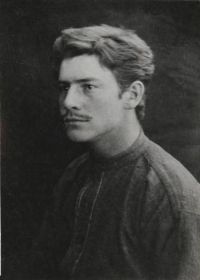
“ A similar ruin, called Casas Grandes, exists in Sonora. The construction is what is called cajon, that is, adobe clay rammed into a box or frame, which is lifted for each successive course as the work advances. In the dry air of that region such walls become extremely hard, and will endure for ages if the foundations are not sapped. [3] Kino paid a second visit to the ruin of Casa Grande in 1697, this time accompanied by Captain Juan Mateo Mange, an officer detailed with his command to escort the padres on their perilous journeys. ”
Cosmos Mindeleff, Casa Grande Ruin
“ There are also some small depressions in the immediate vicinity of the Casa Grande ruin and of the mounds north of it.With a single exception none of these depressions are so situated that they could be used as reservoirs for the storage of water collected from the surface, and the catchment area of the depressions is so small and the rate of evaporation in this area so great that their use as reservoirs is out of the question. It is probable that all of the smaller depressions represent simply sites where building material was obtained. ”
 Geronimo,
Geronimo's Story of His Life
Geronimo,
Geronimo's Story of His Life
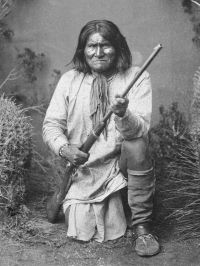
“ Our whole tribe (Bedonkohe Apaches) went through Sonora toward Casa Grande, our destination, but just before reaching that place we stopped at another Mexican town called by the Indians "Kas-ki-yeh." Here we stayed for several days, camping just outside the city. Every day we would go into town to trade, leaving our camp under the protection of a small guard so that our arms, supplies, and women and children would not be disturbed during our absence. ”
1911 Encyclopædia Britannica, Volume 2… (1911)
“ A co-operative social economy is evidenced by the traces of great public works, such as canals many miles in length. The pueblos of the Gila valley are held to be older than those of the Colorado. Casa Grande, 15 m. S.E. of a railway station of the same name on the Southern Pacific railway, is the most remarkable of plain ruins in the South-west, the only one of its type in the United States. It resembles the Casa Grande ruin of Chihuahua, Mexico, with its walls of sun-dried puddled clay, and its area of rooms, courts and plazas, surrounded by a wall. ”
Cosmos Mindeleff, The Repair of Casa Grande Ruin…
“ Florence, Arizona Territory, 9th May, 1891. II. PLANS AND SPECIFICATIONS FOR THE PRESERVATION OF THE CASA GRANDE RUIN, ARIZONA, 1891 (Attached to and forming part of contract) GENERAL REQUIREMENTSAll the work upon this ruin is to be carried out in such a manner as to interfere as little as possible with the present condition and appearance of the building, and the contractors will be held responsible for any injury to it. ”
Cosmos Mindeleff, Casa Grande Ruin
“ When abandoned, however, sapping at the ground level would commence, and would in time level all the walls; yet in the two centuries which have elapsed since Padre Kino's visit—and the Casa Grande was then a ruin—there has been but little destruction, the damage done by relic hunters in the last twenty years being in fact much greater than that wrought by the elements in the preceding two centuries. The relic hunters seem to have had a craze for wood, as the lintels of openings and even the stumps of floor joists have been torn out and carried away. ”
 Robert Sterling Yard,
The Book of the National Parks
Robert Sterling Yard,
The Book of the National Parks
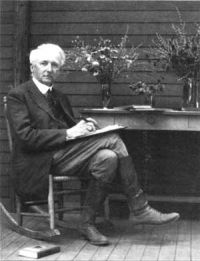
“ Some persons conjecture that observations were made through them of the solstices, and perhaps of some star, to establish the seasons for these primitive people. "The foundation for this unwarranted hypothesis," Doctor Fewkes writes, "is probably a statement in a manuscript by Father Font in 1775, that the 'Prince,' 'chief' of Casa Grande, looked through openings in the east and west walls 'on the sun as it rose and set, to salute it.' The openings should not be confused with smaller holes made in the walls for placing iron rods to support the walls by contractors when the ruin was repaired." ”
Agnes C. Laut, Through Our Unknown Southwest
“ Meantime, the children of the Pimas and Papagoes have not enough to eat owing to the white man taking all their water. They are the people of "the Golden Age," "the Morning Glow."We drove back from Casa Grande by starlight over the antelope plains. I looked back to the crumbling ruins of the Great House, and its five compounds, where the men and women and children of the Morning Glow came to dance and worship according to all the light they had. Its falling walls and dim traditions and fading outlines seemed typical of the passing of the race. Why does one people pass and another come? ”
 Bret Harte,
The Bell-Ringer of Angel's, and Other Stories
Bret Harte,
The Bell-Ringer of Angel's, and Other Stories
“ There it lay—its low whitewashed walls looking like a quartz outcrop of the long lazy hillside—unmistakably hot, treeless, and staring broadly in the uninterrupted Californian sunlight. Yet he knew that behind those blistering walls was a reposeful patio, surrounded by low-pitched verandas; that the casa was full of roomy corridors, nooks, and recesses, in which lurked the shadows of a century, and that hidden by the further wall was a lonely old garden, hoary with gnarled pear-trees, and smothered in the spice and dropping leaves of its baking roses. ”
Walter Wood, A Corner of Spain
“ True, the homes are better than the sordid hovels which are common to Galicia, but the lives of the people are practically the same. I went into one house, and from the dark, primitive kitchen walked into a sleeping-room with an embrasure-like window which framed one of the most perfect landscapes I ever saw—a picture the like of which few people in England below noble rank can command from their own possessions. ”
 Mary Harrod Northend,
Historic Homes of New England
Mary Harrod Northend,
Historic Homes of New England
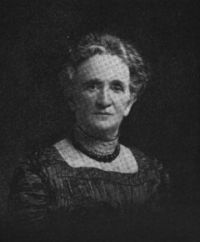
“ The present mansion, remodelled, is to-day a famous landmark. It is considered an excellent example of a colonial home, with its pitched roof, its huge stone chimneys covered with mortar, its dormer windows, and its Georgian porch. One enters through the wide doors into a noble hallway extending entirely through the house, the woodwork showing fine panelling of white pine. The box stairs rise by easy treads to the wide landing, where a colonial window gives light to the apartment. ”
Related terms
Authors who wrote about “Casa Grande”
Benjamin Moore NormanCosmos MindeleffSir M. Digby WyattAgnes C. LautArthur StringerGertrude Franklin Horn Atherton Joseph Conrad
 Mayne ReidChristopher MorleyFrederick Samuel DellenbaughJohn T. ShortW. H. RhodesFrancis Rolt-WheelerJoel CookBret HarteGeronimoRobert Sterling YardFullerton L. Waldo
 George Edmund StreetJohn L. Stephens
Arthur StringerGertrude Franklin Horn AthertonJoseph ConradMayne ReidChristopher MorleyFrederick Samuel DellenbaughJohn T. ShortW. H. RhodesFrancis Rolt-WheelerJoel CookBret HarteGeronimoRobert Sterling YardFullerton L. WaldoGeorge Edmund StreetJohn L. Stephens