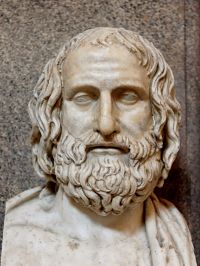
“ The ugly and ill-shapen Crates of Thebes was one of the successors of Antisthenes. A beautiful and popular maiden, Hipparchia, with her brother Metrocles, heard the lectures of Crates, and she was so captivated by his teachings and his manner of life that she became not only his most zealous disciple, but fell violently in love with her teacher. She scorned all her younger, richer, more handsome suitors, and declared that she would have only Crates. She threatened to kill herself if her parents did not secure Crates for her husband. ”
Crates of Thebes
Definition and stakes
Quotes about “Crates of Thebes”
Pierre Loti,
Egypt (La Mort de Philae)
“ We watch the sun descend. But we turn also to see, behind us, the ruins in this the traditional moment of their apotheosis. Thebes, the immense town-mummy, seems all at once to be ablaze—as if its old stones were able still to burn; all its blocks, fallen or upright, appear to have been suddenly made ruddy by the glow of fire. ”
Earl of George Edward Stanhope Molyneux Herbert Carnarvon, Five Years' Explorations at Thebes
“ THE necropolis of Thebes—the great city which for so many centuries had been the capital of Egypt—lies on the western side of the Nile valley, on the margin of the desert opposite the modern village of Luxor. No ancient site has yielded a greater harvest of antiquities than this famous stretch of rocky land. From time immemorial it has been the profitable hunting-ground of the tomb robber; for more than a century a flourishing trade in its antiquities has been carried on by the natives of the district, and for nearly a hundred years archaeologists have been busy here with spade and pencil. ”
Pierre Loti,
Egypt (La Mort de Philae)
“ In spite of the burning sun, and of the clouds of dust raised by the blows of the pickaxes, one might linger for hours amongst the dust-stained, meagre fellahs, watching the excavations in this unique soil—where everything that is revealed is by way of being a surprise and a lucky find, where the least carved stone had a past of glory, formed part of the first architectural splendours, was a stone of Thebes. ”
Mitchell Starrett Buck, Afterglow — The Greek (1924)
“ Upon a housetop beneath the white disc of the moon, Thersites, a Greek, sat with Crobyle and Antonius, who was a Roman soldier. The evening was pleasant. A soft wind blew from the west, bearing with it, now and then, the distant cry of some night-prowler on the desert beyond the tombs of the kings. Spread out on both sides of the silent river lay the crumbling city, Thebes, once mighty and still beautiful, spectral and aloof in the moonlight. Within its temples, old men still clung to well-nigh forgotten ceremonies of the gods. ”
Earl of Beaconsfield Benjamin Disraeli, Sketches
“ The fragment is of red granite, and of admirable workmanship. Unfortunately the face is entirely obliterated. The statue lies upon its back, and in its fall has destroyed all the temple within reach. It measures more than sixty feet round the shoulders, the breadth of the instep is nearly seven feet, and the hieroglyphical figures engraven on the arm are large enough for a man to walk in. Perhaps the most interesting group of ruins at Thebes is the quarter of Medcenet Habu. Most of the buildings are of the time of Rameses the Third. ”
Josiah Williams, Life in the Soudan
“ Thebes, with its hundred gates, was perhaps the most splendid city in the world for many centuries. Then there were Luxor, Karnak, Philæ, Elephantine, Baalbeck, Dendera, Aba-Simbal, Abydos, Esneh, Edfau, Silsilis, and other places, all decorated with palaces, temples, pyramids, tombs, and sphinxes, &c., on the same magnificent scale; but all have shared the same fate, and their stupendous ruins are all that remain to strike the stranger with awe and wonder. ”
Pausanias, The Description of Greece — Book IX (1918)
“ When they are going to sacrifice to him as to a hero, smoke of itself rises up out of the grave. This occurrence, then, I have seen happening. The Thebans show also the tomb of Teiresias, about fifteen stades from the grave of the children of Oedipus. The Thebans themselves agree that Teiresias met his end in Haliartia, and admit that the monument at Thebes is a cenotaph. ”
James Baikie, The Sea-Kings of Crete
“ His tomb at Thebes overlooks the temple which he built at his Queen's command to be 'a paradise for Amen,' and on its walls we can see 'the men from the back of beyond' walking in procession, each with his offering to present to the Pharaoh. There can be no question as to who they are. The half-boots and puttees, the decorated girdle compressing the waist, not quite so tightly as in the Minoan representations, the gaily adorned loin-cloth, which is the only article of attire, all are practically identical with the type of such a fresco as that of the Cupbearer at Knossos. ”
Charles Bucke, Ruins of Ancient Cities (Vol. 2 of 2…
“ Mr. Carne speaks to the same effect:—“It is difficult to describe the noble and stupendous ruins of Thebes. Beyond all others, they give you the idea of a ruined, yet imperishable, city: so vast is their extent, that you wander a long time, confused and perplexed, and discover at every step some new object of interest.”“The temple of Luxor,” says Belzoni, “presents to the traveller, at once, one of the most splendid groups of Egyptian grandeur. ”
Albert Bigelow Paine,
The Ship-Dwellers: A Story of a Happy Cruise
“ Coming from a historian familiar with Athens and Rome in the height of their splendor, this statement is worth considering. We have journeyed to Thebes to see the ruin of the mighty temples which Diodorus saw, and the colossi and the obelisks, and to visit the royal tombs of which he heard—now open to the light of day. ”
Arthur Woollgar Verrall,
Encyclopædia Britannica, Ninth Edition
(1888)
“ The most famous monument of ancient Thebes was the outer wall with its seven gates, which even as late as the 6th century B.O. was probably the largest of artificial Greek fortresses. The names of the gates vary, but four are constant, the Free tides, Electrse, Neistae or Neitse, and Homoloides; Pausanias gives the others as Ogygise, Hypsistse, Crenaese. There is evidence that the gate Electee was on the south, and near it was the tomb of the Thebans who fell at the capture by Alexander. The gates shown to Pausanias as Neistse and Prcetides led respectively north-west and north-east. ”
Thomas De Quincey,
Memorials and Other Papers — Complete
“ Mysterious also is the pomp of ruin with which this revelation of the past descends upon that ancient house of Thebes. Like a shell from modern artillery, it leaves no time for prayer or evasion, but shatters by the same explosion all that stand within its circle of fury. Every member of that devoted household, as if they had been sitting—not around a sacred domestic hearth, but around the crater of some surging volcano—all alike, father and mother, sons and daughters, are wrapt at once in fiery whirlwinds of ruin. ”
E. Berkley, The Pharaohs and Their People: Scenes of old Egyptian life and history
“ At length in the extreme south certain king-like figures emerge of a more commanding appearance, and seen by a clearer light. The Antefs first, a family of ancient and illustrious, though not royal descent, who had set up their dominion at a town then insignificant and unknown to fame—Thebes. The burial-places of the kings of this family (who are [Pg 44] sometimes reckoned in the eleventh dynasty) have been discovered in Western Thebes. Their tombs are plain, and but little ornamented; there are some brick pyramids of no great size, and some fragments of small broken obelisks. ”
Josiah Williams, Life in the Soudan
“ Great was the antiquity of Thebes before European history begins to dawn. It was declining before the foundations of Rome were laid, but the building of the great pyramids of Gizeh preceded the earliest history of Thebes by 1,000 years. Whilst speaking of Thebes, I’ll just mention that there are to be seen to-day the tomb of the great Sethos, Joseph’s Pharaoh, of his greater son, Rameses II., and of Menophres or Meneptha, in whose reign the Exodus took place. In the tomb of Sethos, coloured sculptures cover 320 feet of the excavation. ”
Earl of Beaconsfield Benjamin Disraeli, Sketches
“ It is these domestic details that render also the sepulchres of Thebes so interesting. The arts of the Egyptians must be studied in their tombs; and to learn how this remarkable people lived, we must frequent their burial-places. A curious instance of this is, that, in a tomb near Beni-hassan, we learn by what process the Egyptians procured from the distant quarries of Nubia those masses of granite with which they raised the columns of Karnak and the obelisks of Luxor. ”
Shearjashub Spooner, Anecdotes of Painters, Engravers…
“ Several of these were opened by Belzoni, and were found in great preservation, with mummies in the sarcophagi, as well as dispersed through the chambers.Such was ancient Thebes—a city so populous that, according to ancient writers, in times of war 10,000 soldiers issued from each of her hundred gates, forming an army of 1,000,000 men. That these magnificent ruins are the remains of "the city of an hundred gates,"—"the earliest capital in the world," cannot be doubted. ”
Richard Lepsius, Discoveries in Egypt, Ethiopia and the peninsula of Sinai… (1853)
“ The Theban Necropolis afforded above all places convenience for this new requisition. The tombs of the kings, as well as the private ones, were used as Christian cells, and soon bore on their walls traces of their new destination. In a tomb at Qurna, there is still a letter from St. Athanasius, archbishop of Alexandria, to the orthodox monks of Thebes, preserved on the white stucco in handsome uncials, but unfortunately in a very fragmentary state. They were particularly fond of turning ancient temples into Koptic churches or convents. ”
Georg Ebers,
The Historical Romances of Georg Ebers
“ All the beasts which we saw peopling the Necropolis in the evening had now withdrawn into their lurking places; only man defied the heat of the summer day. Undisturbed he accomplished his daily work, and only laid his tools aside for a moment, with a sigh, when a cooling breath blew across the overflowing stream and fanned his brow.The harbor or clock where those landed who crossed from eastern Thebes was crowded with barks and boats waiting to return. ”
James Hume Nisbet, The Great Secret (1895)
“ They were laughing loudly and passing inane remarks about the ruins, but they could not see that mighty multitude who moved to and fro paying no heed to these nineteenth century innovations. The tourists passed oblivious, and the busy city lived its life. The flesh-controlled blind, and the freeborn indifferent, to what was passing. The city of Thebes, as it was now presented to Philip and Adela, was as it had been in its most palmy days of prosperity, only that the spirits of the embalmed ones had simplified their ceremonials. ”
G. Hartwig, The Subterranean World
“ But not the kings alone; the illustrious, the wealthy, the whole nation reposed in rock-tombs magnificently sculptured or rudely excavated, according to the means of the defunct. Behind the ruins of the stately temples of ancient Thebes, which extend from Gourna to Medinet Abou, and fill the narrow strip of desert between the inundated fields and the foot of the mountains, lies an interminable necropolis, whose 205graves, like the cells of a bee-hive, one close to the other, are hewn in the rocky ground of the plain, or in the slopes of the neighbouring hills. ”
Théophile Gautier,
The Romance of a Mummy and Egypt
“ Sloping revetment walls of unbaked bricks covered the banks, and the crests were lined many files deep by hundreds of thousands of Egyptians, whose white or brightly striped costumes fluttered in the sun with that constant motion character [103] istic of a multitude even when it seems to be motionless. Behind this ring of spectators the cars, chariots, and litters watched by the coachmen, drivers, and slaves, seemed to be the camp of a migrating nation, so great was their number; for Thebes, the wonder of the ancient world, reckoned more inhabitants than do certain kingdoms. ”
Richard Lepsius, Discoveries in Egypt, Ethiopia and the peninsula of Sinai… (1853)
“ Our bark touched the shore first beneath the wall of Luqsor, at the southerly point of the Thebaïc ruins. The strong current of the river has thrust itself so near to the old temple, that it is in great danger. I endeavoured to obtain a general view of the ruins of Thebes from the heights of the temple, in order to compare it with the picture I had idealised to myself, from plans and descriptions.But the distances are too great to give a complete view. One looks into a wide landscape, in which the temple groups are distinguishable only to those who are acquainted with the neighbourhood. ”
Albert Bigelow Paine,
The Ship-Dwellers: A Story of a Happy Cruise
“ From the brink of the great cliff we could look out over the whole plain of Thebes, its villages and its ruins, its green cultivation and its blazing sands. Once it was a vast city—"the city of a hundred gates and twenty thousand chariots of war." Through its centre flowed the Nile, a very fountain of life, its one outlet to the world. To the east and the west lay Nature's surest fortifications, the dead hills and the encompassing sands. It is estimated that the city of Paris could stand on this level sweep and that Thebes overspread it all. ”
active 1837-1839 James Barber, The Overland Guide-book
“ Some little attention is required to see them well. One group is more curious than the rest: the king has caught his adversary with the bow-string, and is decapitating him. Notice the triumphal return to Thebes, and remark the Nile (distinguished by crocodiles) with a bridge thrown across it.To the south of the great temple is a tank, then come several immense propyla, part of an avenue of sphinxes, and lastly some remains of a considerable temple which was surrounded by a lake.To the north are other remains, with a handsome propylon of Ptolemaic date, and an avenue of sphinxes. ”
H. R. Hall, History of Egypt, Chaldea, Syria…
“ The most ancient remains at Thebes were discovered by Mr. Newberry in the shape of two tombs of the VIth Dynasty, cut upon the face of the well-known hill of Shêkh Abd el-Kûrna, on the west bank of the Nile opposite Luxor. Every winter traveller to Egypt knows, well the ride from the sandy shore opposite the Luxor temple, along the narrow pathway between the gardens and the canal, across the bridges and over the cultivated land to the Ramesseum, behind which rises Shêkh Abd el-Kûrna, with its countless tombs, ranged in serried rows along the scarred and scarped face of the hill. ”
H. R. Hall, History of Egypt, Chaldea, Syria…
“ We have already seen that an archaistic revival of the styles of the early dynasties is characteristic of this late period, and that men were buried at Sakkâra and at Thebes in tombs which recall in form and decoration those of the courtiers of the Pyramid Builders. Everywhere we see this fashion of archaism. A Theban noble of this period named Aba was buried at Thebes. Long ago, nearly three thousand years before, under the VIth Dynasty, there had lived a great noble of the same name, who was buried in a rock-tomb at Dêr el-Gebrâwî, in Middle Egypt. ”
John S. C. Abbott,
The Wonders of the World
(1856)
“ No city whatever makes so proud a display at its approach as this wretched village, the population of which consists of two or three thousand souls, who have taken up their abode on the roofs and beneath the galleries of this temple, which has, nevertheless, the air of being in a manner uninhabited.”The tombs of the kings of Thebes are grottos consisting of a regular double gallery supported by pillars, behind which is a row of chambers, often double. In proportion as the hight of these grottos increases, they become more richly decorated ”
Pierre Loti,
Egypt (La Mort de Philae)
“ From all parts of Europe curious and unquiet spirits, as well as mere idlers, turn their steps towards Thebes, the ancient mother. Men clear the rubbish from its remains, devise ways of retarding the enormous fallings of its ruins, and dig in its old soil, stored with hidden treasure. And this evening on one of the portals to which I have just mounted—that which opens at the north-west and terminates the colossal artery of temples and palaces, many very diverse groups have already taken their places, after the pilgrimage of the day amongst the ruins. ”
Louis Couperus,
The Tour: A Story of Ancient Egypt
“ Like Memphis, Thebes spread itself as an immense, ancient, but dying city. For eighty stadia along the Nile its ancient palaces and temples stood in an endless row, forsaken, ruined, cracking, slanting and sinking, with their pillars and walls, their mutilated colossi and sphinxes, their obelisks already fallen to the ground. Even in the sun, a grey melancholy spread over the great city, whose streets, indeed, were [229] crowded with numbers of pedestrians, camels and litters, but without the feverish, metropolitan bustle which had reigned at Alexandria. ”