Douglas Haig

Definition and stakes

J. Walker McSpadden,  Boys' Book of Famous Soldiers

“ Marshal Haig, struck the keynote of his career. From early boyhood
Douglas Haig was going to be a soldier; and he stuck to his guns in a
quiet, systematic way until he won out.
The story of Haig's life until the time of the Great War, was the opposite of spectacular, and even in it, his personal prowess was kept studiously in the background. With him it has always been: "My men did thus and so." Yet in his quiet way he has always made his presence felt with telling effect. He has been the man behind the man behind the gun.
”
Source: Gutenberg

D. H. Parry,  With Haig on the Somme

“ And then his companion slowed down as they approached the quiet château, where worked the keen, well-balanced brain that guided and controlled all those activities, and Dennis found himself in the presence of Sir Douglas Haig, who, after an interview of half an hour's duration, summed up the result of it in a few brief soldierly words.
"You are the very man I was wanting, Mr. Dashwood," he said pleasantly. "Your one object in [Pg 91] life now is to find General Joffre, lay these papers before him, and explain any point upon which the French Generalissimo may be doubtful.
”
Source: Gutenberg

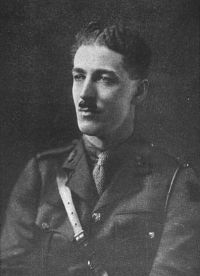
Portrait of Coningsby Dawson Coningsby Dawson,  The Glory of the Trenches

“ He believes that if he and Sir Douglas Haig were to change places, Sir Douglas Haig would be quite as willing to sacrifice himself. He obeys; he doesn't question.
That's the way every Tommy and officer comes to think of God—as a Commander-in-Chief whom he has never seen, but whose orders he blindly carries out.
The religion of the trenches is not a religion which analyses God with impertinent speculation. It isn't a religion which takes up much of His time. It's a religion which teaches men to carry on stoutly and to say, “I've tried to do my bit as best I know how.
”
Source: Gutenberg

Get perspective with Kwize: daily news enlightened by great literature