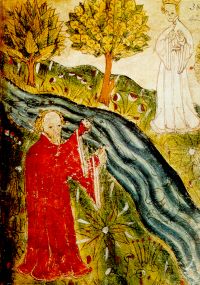
“ In regard to the ruin of the Marquis he felt quite at ease; but he had another cause for anxiety. The struggle would no doubt be a fearful one; Gauvain would direct the assault, and perhaps take part in it. This young chief had all the fire of a soldier; he was the very man to throw himself headlong into this hand-to-hand encounter. And what if he were killed,—Gauvain, his child, the only being on earth whom he loved! Gauvain had been fortunate thus far; but fortune sometimes grows weary. Cimourdain trembled. ”
Gauvain
Definition and stakes
Quotes about “Gauvain”
Victor Hugo,
Ninety-Three
(1874)
“ However, he himself, and he admitted it with anger, did not look on la Tourgue again without a secret thrill; he felt moved by that studious hall where the first books were which he had taught Gauvain to read; he had been priest of the neighboring village, Parigné; he, Cimourdain, had lived in the top of the castle on the bridge; in the library was where he used to hold the little Gauvain on his knees while he learned the alphabet; between these four old walls he had seen his dearly beloved pupil, the son of his soul, grow as a man and increase as a mind. ”
“ Now, if the assault began there, the burning of the bridge would be inevitable, and it seemed to Gauvain that to burn the records would be like attacking his ancestors. The Tourgue was the ancestral manor of the Gauvain family; from this tower started all their fiefs of Brittany, as those of France from the tower of the Louvre. It was the centre round which clustered the family associations of the Gauvains. He himself was born there; and now, led by the tortuous chances of fate, the grown man had come to attack the venerable walls that had protected his childhood. ”
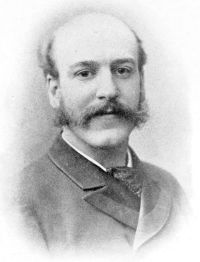
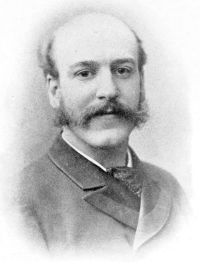
Alfred Trübner Nutt,
Studies on the Legend of the Holy Grail
“ But Perceval, the chief hero, has, as we have already seen, an under-study in Gauvain. And the Gauvain form of the incident deserves as close examination as the Perceval form. (6) Gauvain has met a knight, stranger to him, with whom he travels to Caerleon. Whilst in his company the stranger is slain by a dart cast by whom no one knows. Before dying he bids [Pg 177] Gauvain take his arms and his horse; he knows not why he has been slain, he never harmed anyone. Gauvain suspects and accuses Kex, upon whom he vows to prove the murder, and sets forth to learn the unknown’s name. ”
Victor Hugo,
Ninety-Three
(1874)
“ Gauvain drank and passed the jug to Cimourdain, who drank after him. Gauvain only took one swallow. Cimourdain took a long draught. At this supper, Gauvain ate and Cimourdain drank, a sign of calmness in one and of feverishness in the other. A strange, terrible serenity was in this dungeon. The two men talked. Gauvain said,— "Great things are being planned. What the Revolution is doing at this moment is mysterious. Behind its visible work there is a work invisible. One conceals the other. The visible work is cruel, the invisible work is sublime. ”
Victor Hugo,
Ninety-Three
(1900)
“ Gauvain spoke in a low voice to the sergeant; they removed the straw from their guns; the twelve grenadiers stationed themselves in order of battle behind the corner of the lane, and the seven drummers held their drumsticks in readiness for orders. The discharge of artillery was intermittent. Suddenly, in an interval between two reports, Gauvain raised his sword, and, in a voice which sounded like a trumpet in the silence, cried out,— "Two hundred men to the right, two hundred men to the left, the rest in the centre!" ”
Victor Hugo,
Ninety-Three
(1900)
“ Why not Gauvain? said Cimourdain to himself; and he went on dreaming. The unbounded was before him; he passed from one hypothesis to another; all obstacles vanished; when one has once set his foot on this ladder he does not stop, it is an endless climb, one leaves man to reach the stars. A great general is only a chief of armies; a great captain is at the same time a chief of ideas; Cimourdain imagined Gauvain a great captain. It seemed to him, for dreams move swiftly, that he saw Gauvain on the ocean, repelling the English ”
“ Gauvain, Republican as he was, believed himself to be and was just; but a superior law had been revealed.Human law takes a higher stand than the law of revolutions. This affair now in progress could not be evaded; it was a serious matter, and Gauvain formed a part of it; he was involved in it, and could not extricate himself; and however much Cimourdain might say, "This matter no longer concerns you," he felt all the sensations of a tree torn up by its roots.Every man has a basis; a shock to this basis produces a serious disturbance; and this was what Gauvain now felt. ”
“ Guéchamp had joined Gauvain. Pursuit was manifestly out of the question; the escape had been successful; everything was in favor of the fugitives,—the entire country, the underbrush, the ravines, the copses, and even the inhabitants themselves. No doubt they were far enough away by this time; there was no possibility of finding them, and the entire forest of Fougères was one vast hiding-place. What was to be done? They saw themselves forced to begin the whole affair over again. Gauvain and Guéchamp exchanged their regrets and conjectures.Cimourdain listened gravely without uttering a word. ”
Victor Hugo,
Ninety-Three
(1874)
“ That is your affair. You are traitors and cowards, incapable of devotion and sacrifice. I have spoken. Now have me guillotined, monsieur le vicomte. I have the honor to be your most humble servant." And he added, "Ah! I tell you the truth about yourself! What difference will it make to me? I am dead." "You are free," said Gauvain. And Gauvain stepped towards the marquis, took off his commander's cloak, threw it over Lantenac's shoulders and pulled the hood down over his eyes. They were of the same height. ”
Victor Hugo,
Ninety-Three
(1874)
“ The old man, who is shrewd, makes a point; they learn that he is marching on Dol. If he takes Dol, and if he establishes a battery on Mont-Dol, for he has cannon, there is a point of the coast where the English can land, and all is lost. That is why, as there was not a minute to lose, Gauvain, who is a level-headed man, took counsel with no one but himself; did not ask for orders, nor wait for them, sounded the signal to saddle, put to his artillery, collected his troops, drew his sabre, and that is how, while Lantenac was rushing on Dol, Gauvain was rushing on Lantenac. ”
Victor Hugo,
Ninety-Three
(1900)
“ They lighted up the main streets with fire pots. It was strewn with dead and wounded. The end of a battle is always heartrending. A few groups of desperate men here and there still resisted; they were surrounded and they laid down their arms. Gauvain had noticed in the lawless confusion of the rout, a bold man, a sort of nimble, hardy faun, who had aided the flight of others but had not fled himself. This peasant made masterly use of his carbine, shooting with the barrel, felling with the stock so well that he had broken it; now he had a pistol in one hand and a sword in the other. ”
Victor Hugo,
Ninety-Three
(1900)
“ As soon as the ominous conference just heard, was ended, Gauvain's first care was to call his lieutenant. Guéchamp, whom it is necessary to know somewhat, was a man of secondary abilities, honest, fearless, ordinary, a better soldier than leader, strictly intelligent to the point where it was his duty to understand no further, never compassionate, inaccessible to corruption of any sort, to venality which corrupts conscience, as well as to pity which corrupts justice. ”
“ What! here is Commander Gauvain, who for these four months past has been driving those donkeys of Royalists to the sound of the drum, who saves the Republic by his sword, and who did something at Dol that needed brains to accomplish it; and when you have a man like that, you try to get rid of him, and instead of making him your general you propose to cut his throat! I say that it is enough to make one throw one's self head-foremost from the Pont-Neuf! and if you, citizen Gauvain, were only a corporal instead of being my commander, I would tell you that you talked a heap of nonsense just now. ”
Alfred Nutt,
Studies on the legend of the Holy Grail
(1888)
“ A squire rides up very hideous of aspect, mounted on a wretched hack. Gauvain chastises him for discourteous answers; meanwhile the wounded knight makes off with Gauvain's steed, making himself known as Griogoras, whom Gauvain had once punished for ill-doing. Gauvain has to follow the damsel upon the squire's hack, comes to a river, on the other side of which is a castle, overcomes a knight who attacks him, during which the damsel vanishes, is ferried across the stream, giving the vanquished knight to the ferryman as toll ”
Alfred Nutt,
Studies on the legend of the Holy Grail
(1888)
“ Gauvain rides on to Tingaguel to help its lord. On arriving at the castle the eldest daughter jeers at him, whilst the youngest takes his part, declaring him a better knight than Melians, whereat her sister is very indignant. On the first day of the tournament Melians shows himself the best knight, but the younger sister still declares her faith in Gauvain, and has her ears boxed in consequence. She appeals to Gauvain to be her knight and avenge the injury done her. He consents, overcomes Melians, whose horse he sends to his little lady, and all other knights ”
Victor Hugo,
Ninety-Three
(1900)
“ He had let Gauvain begin the siege on the opposite side. La Tourgue had its savage side, the tower, and its civilized side, the library. Cimourdain had allowed Gauvain to make a breach only on the savage side. Moreover, this old dwelling, attacked by a Gauvain, defended by a Gauvain, was returning, in the midst of the French Revolution, to its feudal customs. Wars between relatives make up the entire history of the Middle Ages; the Eteocles and Polynices are Gothic as well as Greek, and Hamlet does at Elsinore what Orestes did in Argos. ”
Victor Hugo,
Ninety-Three
(1874)
“ Cimourdain, Guéchamp, and Radoub had gone down into the ravine; Gauvain had gone back into the hall in the second story of la Tourgue, where were the turning stone, the secret way of escape, and the iron door of the library. It was there that l'Imânus had lighted the sulphur match; it was there that the fire had started. Gauvain had taken twenty sappers with him. The only resource was to break open the iron door. It was fatally closed. They began by using axes. The axes broke. A sapper said,— "Steel is like glass against this iron." ”
Alfred Trübner Nutt,
Studies on the Legend of the Holy Grail
“ After praying in a chapel, in which he beholds a light on the altar quenched by a black hand, he rides through Brittany and Normandy, and comes to a castle where, owing to his armour, he is at first hailed as lord. In one of the rooms stands a bier, whereon lies a knight, cross and broken sword upon his body, his left hand bleeding. A crowned knight enters and goes to battle with Gauvain; canons and clerks come and perform the Vigil of the Dead; whilst at table Gauvain sees the rich Grail serving out bread and wine to the knights. ”
Victor Hugo,
Ninety-Three
(1900)
“ Gauvain, with the imprudence of a young general, was in the lower hall, in the thickest of the fight, in the midst of all the firing. We may add that he had the confidence of a man who had never been wounded. ”
“ A few moments later, Gauvain and Cimourdain, followed by the others, entered the hall. They all saw the opening, and after searching every corner and exploring the staircase which led down into the ravine, they felt very sure that the enemy had escaped. They shook the Imânus, but he was dead. Gauvain, with lantern in hand, examined the stone which had furnished the fugitives with a means of escape. ”
Victor Hugo,
Ninety-Three
(1874)
“ Holding his sword in his hand, under his crossed arms, he stood in the flare of a torch which lighted up his battery, watching all this darkness attentively. His tall figure in this bright light made him visible to the men behind the barricade. He was their aim, but he was not aware of it. The discharge of bullets sent from the barricade fell all around Gauvain, who was absorbed in thought. But against all these carbines he had the cannon. The cannon ball always gets the advantage. He who has artillery has victory. ”
Victor Hugo,
Ninety-Three
(1874)
“ When they learned of Gauvain's sentence, there was a second murmur, "That is too much! our chief, our brave chief, our young commander, a hero! He is a viscount, well it is all the more credit to him for being Republican! What! he, the liberator of Pontorson, of Villedieu, of Pont-àu-Beau! The conqueror of Dol and of La Tourgue! He through whom we are invincible; he who is the sword of the Republic in la Vendée! The man who, for five months, has held the Chouans at bay, and made up for all the folly of Léchelle and the rest! This Cimourdain dares condemn him to death! Why? ”
Victor Hugo,
Ninety-Three
(1900)
“ Having done this, Cimourdain went to find Gauvain; just then the distant church of Parigné sounded eleven o'clock in the evening; Cimourdain said to Gauvain,— "I am going to convoke a court-martial; you will not take part in it. You are a Gauvain, and Lantenac is a Gauvain. You are too nearly related to be a judge ”
Victor Hugo,
Ninety-Three
(1874)
“ A cold wind was blowing in the forest. Gauvain, leaving Guéchamp to give the necessary orders, went to his tent in the meadow on the border of the wood, at the foot of la Tourgue, and got his hooded cloak and wrapped himself up in it. This cloak was edged with the simple braid which, according to the Republican fashion for sober ornaments, designated the commander-in-chief. ”
Victor Hugo,
Ninety-Three
(1874)
“ And this is what all the battalion say: 'We want the children saved, or we want to be all killed. This is our right, yes, to be all killed.' And now, good luck and reverence." Gauvain held out his hand to Radoub, and said,— "You are a brave man. You shall be in the attacking column. I will divide you. I will put six of you with the vanguard, that the troops may be sure to advance, and I will put six of you in the rearguard, to keep them from retreating." ”
“ To-day the two branches are fighting each other. You never see this among trees, but often among men. This Marquis de Lantenac is all-powerful in Brittany; the peasants regard him as a prince. On the very day he landed he rallied eight thousand men; in a week three hundred parishes had risen. If he had only been able to establish a foothold on the coast, the English would have made a descent. Luckily Gauvain, who, strange to say, is his grand-nephew, was on the spot. He is a Republican commander, and has got the upper hand of his great-uncle. ”
Victor Hugo,
Ninety-Three
(1874)
“ The unforeseen, that strange, haughty power which plays with man, had seized Gauvain and held him fast. ”
Alfred Trübner Nutt,
Studies on the Legend of the Holy Grail
“ GAWAIN. Gauvain Co, Q, GG, Gwalchmai M, Gawan W, Gawein H, Gawayne or Wawayne T——of the seed of Joseph of Arimathea GG48, Arthur’s nephew Co, Q——conquers Blihos Bliheris PC2——allusion to his finding the Grail PC3——one of the knights met by Perceval in wood M1, T2——helps Perceval to disarm Red Knight T4——meeting with Perceval after blood-drops incident C10, W, M11——vow to release imprisoned maiden C11, M20——reproached by Guigambresil C12, (Kingrimur) W, (anonymous) M20——tournament at Tiebaut’s C13, (Lippaot) W, (Leigamar) H, cf. ”
Pearl Poet,
Sir Gawain and the Green Knight
“ Sir Gawain the good, that glad was withalamong the ladies; in their love he had much joy.He wore a mantle of blue that reached to the earth;his surcoat, that was softly furred, became him well;and his hood of the same hung on his shoulder.Trimmed all about with fine fur were both.He met this good man in the middle of the floor,and all joyfully he greeted him, and goodly he said:"Now I shall fulfill our covenant,that we have just made, where no drink was spared."Then he embraces the knight and kisses him thricewith as much gusto and as soberly as he could give them. ”