“ And he withdrew his head, and went forth, “Ha! p. 97chieftain,” said the maiden, “if thou wilt do as I counsel thee, thou wilt shut the door, lest the man should have a plot against thee.” Upon that Gwalchmai arose, and when he came near unto the door, the man, with sixty others, fully armed, were ascending the tower. And Gwalchmai defended the door with a chessboard, that none might enter until the man should return from the chase. And thereupon, behold the earl arrived. ”
Gwalchmai
Definition and stakes
The theme of “Gwalchmai” has been addressed by authors such as Sidney Lanier, Andrew Lang, T. W. Rolleston, Jonathan Ceredig Davies and Charlotte M. Yonge. It is often associated with terms like Owain, Arthur, Gilgamesh, knight and baron.
Quotes about “Gwalchmai”
 Sidney Lanier,
Knightly Legends of Wales; or, The Boy's Mabinogion
(1884)
Sidney Lanier,
Knightly Legends of Wales; or, The Boy's Mabinogion
(1884)
“ And they rose up speedily and drew their swords and resumed the combat. And the multitude that witnessed their encounter felt assured that they had never before seen two men so valiant or so powerful. And, had it been midnight, it would have been light from the fire that flashed from their weapons. And the knight gave Gwalchmai a blow that turned his helmet from off his face, so that the knight knew that it was Gwalchmai. Then Owain said, "My lord Gwalchmai, I did not know thee for my cousin, owing to the robe of honor that enveloped thee. Take my sword and my arms." ”
The Mabinogion — Peredur the Son of Evrawc (1877)
“ Little praise and honour, nevertheless, wilt thou have from vanquishing a weary knight, who is tired with fighting. Yet thus hast thou gained the advantage over many. And while thy speech and thy soft words last, a coat of thin linen were armour sufficient for thee, and thou wilt not need to break either lance or sword in fighting with the knight in the state he is in." Then said Gwalchmai to Kai, "Thou mightest use more pleasant words, wert thou so minded: and it behoves thee not upon me to wreak thy wrath and thy displeasure. ”
The Mabinogion — The Lady of the Fountain (1877)
“ And Owain defended the Fountain with lance and sword. And this is the manner in which he defended it: Whensoever a knight came there he overthrew him, and sold him for his full worth, and what he thus gained he divided among his barons and his knights; and no man in the whole world could be more beloved than he was by his subjects. And it was thus for the space of three years. It befell that as Gwalchmai went forth one day with King Arthur, he perceived him to be very sad and sorrowful. And Gwalchmai was much grieved to see Arthur in this state ”
Sidney Lanier,
Knightly Legends of Wales; or, The Boy's Mabinogion
(1884)
“ Now I am sure that it is through the tale which Kynon, the son of Clydno, related, that I have lost Owain.""There is no need for thee," said Gwalchmai, "to summon to arms thy whole dominions on this account; for thou thyself and the men of thy household will be able to avenge Owain if he be slain, or to set him free if he be in prison, and if alive to bring him back with thee." And it was settled according to what Gwalchmai had said.Then Arthur and the men of his household prepared to go and seek Owain; and their number was three thousand, besides their attendants. ”
Jonathan Ceredig Davies, Folk-Lore of West and Mid-Wales
“ After the Goblin had left Einion, the son of Gwalchmai, she went to Treveilir in the form of an honourable and powerful nobleman elegantly and sumptuously appareled, and possessed of an incalculable amount of gold and silver, and also in the prime of life, that is thirty years of age. And he placed a letter in Angharad’s hand in which it [142] was stated that Einion had died in Norway more than nine years before, and he then exhibited his gold and wealth to Angharad ”
 Charlotte M. Yonge,
History of Christian names
(1884)
Charlotte M. Yonge,
History of Christian names
(1884)
“ In a Welsh poem, he is represented as using his courteous tongue in behalf of his friend Trystan; and in the Mabinogion, in the ‘Lady of the Fountain,’ he takes such a prominent part, that the French romance is called that of Sir Yvaine and Sir Gawaine. Walganus and Walwyn had Latinized the Hawk of Battle, and have caused it to be confounded with the Teutonic Walwine, slaughter-lover; but the Gwalchmai of Wales can be identified with the Gawain, or Wawyn, of romance by his friendship with Trystan, his relationship to Arthur, and his title in the romances of the Flower of Courtesy. ”
 Alfred Nutt,
Studies on the legend of the Holy Grail
(1888)
Alfred Nutt,
Studies on the legend of the Holy Grail
(1888)
“ One day he sees three knights passing—Gwalchmai, the son of Gwyar, and Geneir Gwystyl, and Owain, the son of Urien. His mother declares them to be angels; whereupon he determines to join them. He questions Owain concerning his accoutrements and the use of his weapons. His mother swoons away at the thought of his leaving her; but he picks out a horse and saddles it. Before leaving, his mother counsels him to repeat his paternoster wherever he sees a church; to take food and drink if none offer them; to aid when any outcry is, especially a woman's ”
 Brand Whitlock,
The Gold Brick
(1910)
Brand Whitlock,
The Gold Brick
(1910)
“ Something in the man, in the moment, impelled awe. He set his hand to the paper to write, but paused an instant longer. His eyes wandered from the document. As he raised them over her, the woman bowed her head. Out through the open window, out through the summer morning, over the wimpling foliage of the trees, far, far away they gazed. And then he sighed, as a woman sighs, and turning, signed the pardon of Thomas Whalen. A moment he sat still as an ancient statue, and then dropping the pen on the desk, he turned toward Gilman with a smile. ”
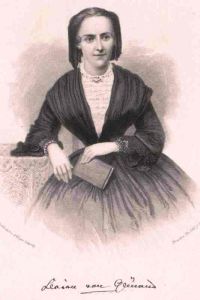 Claire von Glümer,
A Noble Name; or, Dönninghausen
Claire von Glümer,
A Noble Name; or, Dönninghausen
“ The next morning early the Freiherr sent to Klausenburg for Otto, who made his appearance without delay."It is terrible to be persecuted by misfortune as I am," he said to himself, as he went up-stairs. "Every stupidity I commit comes to the old man's ears, and he instantly falls foul of me. And what have I done, after all? I should like to know whether Johann Leopold and Waldemar have not had their escapades too? ”
Claire von Glümer,
A Noble Name; or, Dönninghausen
“ Waldemar is intensely mortified——""No need of that," the Freiherr interposed. "We have been long-suffering enough. Now turn the scoundrel out of doors, and——Basta! There are black sheep in every family! Let him go!" An energetic flourish of his hand emphasized his words. The Freiherr walked on silently for a few moments, and then said, "We were talking of Waldemar's possible return. What could we do with him here? It is not his fashion to play the sluggard.""No need for him to do that," Johann Leopold replied. ”
Stephen Langdon, The Epic of Gilgamish
“ The contents supply the South Babylonian version of the second book of the epic ša nagba imuru, “He who has seen all things,” commonly referred to as the Epic of Gilgamish. The tablet is said to have been found at Senkere, ancient Larsa near Warka, modern Arabic name for and vulgar descendant of the ancient name Uruk, the Biblical Erech mentioned in Genesis X. 10. This fact makes the new text the more interesting since the legend of Gilgamish is said to have originated at Erech and the hero in fact figures as one of the prehistoric Sumerian rulers of that ancient city. ”
Claire von Glümer,
A Noble Name; or, Dönninghausen
“ Aunt Thekla gazed after it with tearful eyes, Johann Leopold in proud resignation, and the Freiherr with a desire to bid defiance to the past and to clutch what still seemed to him worth possessing. It was he who at last broke the silence."This can't go on so!" he said, rising and pacing the room to and fro, after his usual fashion. "Next year, God willing, shall see childish faces around our Christmas-tree. The future heir belongs to us. Since Waldemar has just had another boy, he must give us the oldest." ”
William Wilkinson, An account of the principalities of Wallachia and Moldavia (1820)
“ The number of gypsies belonging to the two governments, altogether amounts to eighty thousand, including women and children. They are suffered to stroll about the country, provided they bind themselves never to leave it, and to pay an annual tribute of the value of forty piasters each man, above the age of fifteen. We have mentioned on the subject of the gold and silver mines, how those of Wallachia pay their share of it. ”
Stephen Langdon, The Epic of Gilgamish
“ Gilgamish receives him and they dedicate their arms to heroic endeavor. At this point the epic brings in a new and powerful motif, the renunciation of woman’s love in the presence of a great undertaking. Gilgamish is enamoured of the beautiful virgin goddess Išhara, and Enkidu, fearing the effeminate effects of his friend’s attachment, prevents him forcibly from entering a house. A terrific combat between these heroes ensues,10 in which Enkidu conquers, and in a magnanimous speech he reminds Gilgamish of his higher destiny. ”
 Julian Hawthorne,
Idolatry: A Romance
Julian Hawthorne,
Idolatry: A Romance
“ Gnulemah could not be called talkative, yet in giving her thoughts expression she outdid vocabularies. Many fine muscles there were around her eyes, at the corners of her mouth, and especially in the upper lip,—whose subtile curvings and contractions spoke volumes of question, appeal, observation. Her form by its endless shiftings uttered delicate phrases of pleasure, surprise, or love; her hands and fingers were orators, and eloquent were the curlings and tappings of her Arab feet. ”
Sir E. A. Wallis Budge, The Babylonian Story of the Deluge as Told by Assyrian Tablets from Nineveh
“ Who is glorious among heroes?" these questions were answered by the women of the palace who cried: "Gilgamish is splendid among men. Gilgamish is glorious among heroes." When Gilgamish entered his palace he ordered a great festival to be kept, and his guests were provided by him with page 49beds to sleep on. On the night of the festival Enkidu had a dream, and he rose up and related it to Gilgamish. ”
Stephen Herbert Langdon, The Epic of Gilgamish (1917)
“ He rapidly learns the customs of men, becomes a shepherd and a mighty hunter. At last he comes to the notice of Gilgamish himself, who is shocked by the newly acquired manner of Enkidu. “Oh harlot, take away the man,” says the lord of Erech. Once again the faithful woman instructs her heroic lover in the conventions of society, this time teaching him the importance of the family in Babylonian life, and obedience to the ruler. Now the people of Erech assemble about him admiring his godlike appearance. Gilgamish receives him and they dedicate their arms to heroic endeavor. ”
Claire von Glümer,
A Noble Name; or, Dönninghausen
“ Otto had grown pale. He seemed to wish to speak, but only breathed heavily and hung his head.Aunt Thekla felt impelled to interfere. "Dear Johann, I entreat you——" she began in a trembling voice.The Freiherr interrupted her. "Hush, Thekla; you understand nothing about it," he said, harshly.But she was not to be intimidated. "What will become of the poor boy?" she asked, softly."You are right,—the poor boy!" the Freiherr exclaimed, with a scornful laugh. "It is strange that such fellows can always wheedle you women. ”
Claire von Glümer,
A Noble Name; or, Dönninghausen
“ Stein's newspaper notice. "Nonsense!" he said, knitting his brows. "There are just as many lies printed as uttered. But what do you mean by the two who are to blame? What business is the affair of yours? You are and always were an insolent fellow——""Squire!" shouted Red Jakob, and an evil light shone in his deep-set eyes; but, after a pause, he continued, more gently: "I do deserve a scolding this time, although not for what you think. It fretted me to see the gracious Fruleen so deceived. I saw them both in the forest—Squire Otto and Frau von Magelone—who was at Klausenburg on a visit. ”
William Wilkinson, An account of the principalities of Wallachia and Moldavia (1820)
“ It is customary in Wallachia for parents to interfere in their married children’s family concerns, and to exercise nearly the 151same authority over them after marriage as before. They are often seen as busy in intriguing to bring on a separation, as they had been active in seeking husbands or wives for them. ”
Claire von Glümer,
A Noble Name; or, Dönninghausen
“ This tramping round among the Wildenhayns and Walburgs is positively disreputable. Write that to her; do you hear?"The servant brought in the lamp. When he had departed, Johann Leopold said, "I have something to tell you of Magelone. An hour ago I received a letter by express. I could not make up my mind to tell you before——""Deuce take you, lad! Out with it!" cried the Freiherr. "What is the matter with the child? Is she sick—dead?""Nothing of the kind. She has only asserted her right to do as she pleases. She is married——""Married!" the brother and sister exclaimed, as with one voice. ”
An Old Babylonian Version of the Gilgamesh Epic (1920)
“ In the first column of the obverse of the Yale tablet, which is badly preserved, it would appear that the elders of Erech (or perhaps the people) are endeavoring to dissuade Gilgamesh from making the attempt to penetrate to the abode of Ḫuwawa. If this is correct, then the close of the first column may represent a conversation between these elders and the woman who accompanies Enkidu. It would be the elders who are represented as “reporting the speech to the woman,” which is presumably the determination of Gilgamesh to fight Ḫuwawa. ”
Claire von Glümer,
A Noble Name; or, Dönninghausen
“ We were all so glad.""Thank you for your kindness, Fräulein von Dönninghausen. I did think for a while of remaining at home, but I seem to be turning out an irreclaimable vagabond." Ludwig spoke in a quiet, cheerful tone, but neither Aunt Thekla nor Johann Leopold could avoid an impression that he was exercising a certain self-control, and they scrutinized him keenly.The Freiherr frowned: "I should be sorry for that! You are made of better stuff than goes to make up these new-fangled tramps. Stay here, young man! You'll find enough to do in Germany." ”
Brand Whitlock,
The Gold Brick
(1910)
“ Gilman, as he returned to his desk, smiled and shook his head at the governor’s weakness.Thomas Whalen was a life convict in the penitentiary. The crime was committed on the night of the election at which John Chatham had been chosen chief executive of his state. Whalen was a boss in the nineteenth ward and a Chatham man. The campaign had developed such bitterness that Whalen found it necessary to name himself a judge of election in the fourth precinct of his ward. Many times during the day blue patrol wagons had rolled into the precinct. ”
Sir E. A. Wallis Budge, The Babylonian Story of the Deluge as Told by Assyrian Tablets from Nineveh
“ A summary of the contents of the other Tablets of the Gilgamish Series is given in the following section of this short monograph. It is therefore only necessary to state here that Gilgamish, who was horrified and almost beside himself when his bosom friend and companion Enkidu () , Eabâni) died, meditated deeply how he could escape death himself. He knew that his ancestor Uta-Napishtim () had become immortal, therefore he determined to set out for the place where Uta-Napishtim lived so that he might obtain from him the secret of immortality. ”
Lincolnshire rector of Ruckland George Hall, The Gypsy's Parson: his experiences and adventures
“ Reverting to the Watlands, I was not disappointed. There in a hollow on the moor I found them squatting around their fires. Wearied by travel, some of the elders had retired for the night. “Dik lesti’s pîro” (look at his foot) , said one of the boys, pointing to a man’s bare brown foot protruding from beneath a tent cover. Within view of Durham’s twinkling lights we sat, and my tobacco pouch having gone the round, we were soon deep in the sayings and doings of the Watlands of other days, for when business is off Gypsies ever talk of Gypsies. ”
Sir E. A. Wallis Budge, The Babylonian Story of the Deluge as Told by Assyrian Tablets from Nineveh
“ Then Gilgamish took them to the temple of the god Lugalbanda and hung them up there on the throne of his majesty, and having made his offering he and Enkidu went to the Euphrates and washed their hands, and walked back to the market-place of Erech. As they went through the streets of the city the people thronged about them to get a sight of their faces. When Gilgamish asked: "Who is splendid among men? ”
Claire von Glümer,
A Noble Name; or, Dönninghausen
“ I have something to say to you," the Freiherr ordered, as he turned to leave the room. Johann Leopold changed colour; the Freiherr noticed it, and the veins in his forehead began to swell. "Why do you turn so pale?" he asked, angrily. "Do me the favour to sit down, or I shall have you fainting away shortly. You are ill, nervous, and must be treated cautiously, Thekla says. Deuce take it! Brace yourself, my lad, and cheer up! The heir of Dönninghausen must not go lagging about like an hysterical girl!" ”
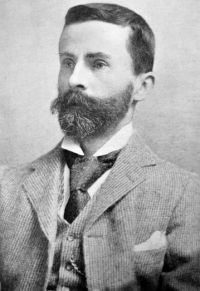 Francis Hindes Groome,
Gypsy folk-tales
(1899)
Francis Hindes Groome,
Gypsy folk-tales
(1899)
“ They are in fact very able artisans and labourers, industrious and active, but are cruelly and barbarously treated. In the houses of their masters they are employed in the lowest offices, live in the cellars, have the lash continually applied to them, and are still subjected to the iron collar and a kind of spiked iron mask or [xxii] helmet, which they are obliged to wear as a mark of punishment and degradation for every petty offence.’ The Gypsies of Wallachia and Moldavia are referred to in eleven original documents of the fourteenth, fifteenth, and sixteenth centuries. ”