“ The greatest debtor connected with science was John Hunter, who expended all his available means—and they were wholly earned by himself—in accumulating the splendid collection now known as the Hunterian Museum. ”
Hunterian Museum
Definition and stakes
The theme of “Hunterian Museum” has been addressed by authors such as Margaret Talbot Jackson, Arthur E. P. Brome Weigall, George Thomas Bettany, Edward Edwards and Louis Agassiz. It is often associated with terms like art, hunter, British, collection and history.
Quotes about “Hunterian Museum”
D'Arcy Power, Dictionary of National Biography… (1912)
“ But unhappily the lectures were neither published nor reported, and only remain in the memories of his auditors or in their scanty notes. His valuable work survives alone in the catalogues of the Hunterian museum. ”
The Book of Scottish Song (1843)
“ John Hunter, wife of the distinguished anatomist and physiologist, John Hunter, whose brother, William, founded the Hunterian Museum at Glasgow. Her maiden name was Anne Home, and she was the eldest daughter of Robert Home of Greenlaw, in Berwickshire, a surgeon in the army. ”
R. Austin Freeman, The Uttermost Farthing: A Savant's Vendetta
“ There are recent human skeletons in the Natural History Museum; every art school in the country has one and so have many board schools. What is the legal position of the owners of those human remains? It will not bear investigation. As to the Hunterian Museum, it is a mere resurrectionist's legacy. That the skeleton of O'Brian was obtained by flagrant body-snatching is a well-known historical fact, but one at which the law, very properly, winks. ”
Various, Encyclopaedia Britannica, 11th Edition…
“ A classified subject-catalogue has been printed, and there is also a printed dictionary catalogue. The annual accessions are about 1500, and the commutation-grant £707. Connected with the university, which is trustee for the public, is the library of the Hunterian Museum, formed by the eminent anatomist Dr William Hunter. It is a collection of great bibliographical interest, as it is rich in MSS. and in fine specimens of early printing, especially in Greek and Latin classics. There are about 200,000 vols. in the library. ”
 G. T. Bettany,
Eminent doctors: Their lives and their work…
(1885)
G. T. Bettany,
Eminent doctors: Their lives and their work…
(1885)
“ The portrait of him by Sir Joshua Reynolds adorns the Hunterian Museum at Glasgow. An unfinished painting by Zoffany represents him in the attitude of lecturing on the muscles at the Royal Academy, surrounded by academicians. Hunter’s portrait is the only completed part. It was presented to the College of Physicians by Mr. Bransby Cooper in 1829.We hear of no matrimonial projects at any time on William Hunter’s part. He was wedded to his museum, his profession, his lectures. He lived a [Pg 132] frugal life, eating little food, and that plainly prepared; rising early, and being always at work. ”
Various, Harper's New Monthly Magazine, No…
“ The rest of the lecture was on education. Education should not be called education, but initiation—that was all. Not a word of history. Tremendous applause as he concluded. FREAKS OF NATURE.The celebrated Hunterian Museum in London contains, perhaps, the largest collection of natural curiosities, especially in the department of anatomy, in the world. One of the most striking specimens, described in the catalogue, is the skeleton of a boy, born in Bengal some seventy years ago, remarkable for the singular conformation of his head. ”
G. T. Bettany,
Eminent doctors: Their lives and their work…
(1885)
“ His name and achievements are annually commemorated by orations such as those from which the subsequent extracts are made, but most of all by the Hunterian Museum and the lectures delivered in connection therewith.To expound Hunter’s views of life, and the results of his other philosophical and practical studies, would lead us far beyond our limits. Life he regarded as a principle independent of structure; as a great chemist; as a sort of animal fire. “Mere composition of matter,” he said, “does not give life ”
Popular Science Monthly (1883)
“ In this position it was his duty to make the catalogue of the Hunterian collection; and he prepared catalogues of the "Pathological Specimens," "Monsters and Malformations," and, chiefly, of the "Specimens of Natural History in Spirits," in 1830 and 1831. He continued the study of these collections through many years, succeeding Clift as curator of the museum on his death, and was gradually led by them to the extensive field of research with which his name is connected. ”
George Macilwain, Memoirs of John Abernethy
“ It holds the monument of the untiring labour of a great master—the rich garnerings of a single mind—the record, alas! but of some of the obligations mankind owe to the faithful pioneer of a Science which, however now partially merged in clouds and darkness, and obscured by error, still exhibits through the gloom, enough to assert its lofty original, and to foster hopes of better times.The museum of John Hunter (for it is of that we write) is one of the greatest labours ever achieved by a single individual. ”
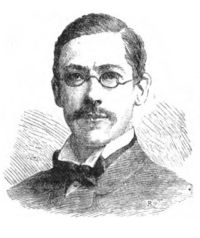 George Thomas Bettany,
Dictionary of National Biography…
(1891)
George Thomas Bettany,
Dictionary of National Biography…
(1891)
“ The ‘Observations' were at first intended for the Royal Society; but objections were made by a geological friend to his use of language which implied that the earth was more than six thousand years old, and he consequently did not send in the paper to the society. Hunter's works, and especially his posthumous papers, contain numerous psychological remarks, exhibiting much originality and shrewdness, without evidence of systematic study. Hunter designed his museum to illustrate the entire phenomena of life in all organisms, in health and disease. Its essential plan was physiological. ”
Arthur Thomas Malkin, The Gallery of Portraits: with Memoirs…
“ Hunter, Dr. Fordyce, Sir Joseph Banks, Dr. Solander, Dr. Maskelyne, Sir George Shuckburgh, Sir Henry Englefield, Sir Charles Blagden, Mr. Ramsden, and Mr. Watt. To be the associate of such men could not but have a good effect on a mind like Hunter’s, active and vigorous, but deficient in general acquirement, and concentrated upon one pursuit.At this time, and for many years afterwards, he was employed in the most curious physiological inquiries; and at the same time forming that museum, which remains the most surprising proof both of his genius and perseverance. ”
Various, The Irish Penny Journal, Vol. 1 No…
“ John Hunter was as remarkable for his industry as for his talents, of which his museum alone forms a most extraordinary proof; and if we look around and contemplate the history of those men whose talents and acquirements we must esteem, we find that their superiority of knowledge has been the result of great labour and diligence. ”
Arthur Thomas Malkin, The Gallery of Portraits: with Memoirs…
“ It is strange that Sir Everard Home should have considered this collection as a proof of the patronage Hunter received. He had many admirers, and many persons were grateful for his professional assistance; but he had no patrons. The extent of his museum is to be attributed solely to his perseverance; a quality which is generally the companion of genius, and which he displayed in every condition of life. ”
George Thomas Bettany,
Dictionary of National Biography…
(1891)
“ His anatomical and pathological collections had become enriched by large purchases from the collections of Francis Sandys [q.v.] , Hewson, Magnus Falconar, Andrew Blackall, and others. He now added to it coins and medals, minerals, shells, and corals, and a remarkable library of rare and valuable Greek and Latin books. Hunter's duplicates when disposed of in 1777 furnished material for seven days' sale. In 1781 Dr. Fothergill's large collection, under the terms of his will, was added to Hunter's at a cost of 1,200l. In 1783 Hunter calculated that his museum had cost him 20,000l. ”
 John Ruskin,
On the Old Road Vol. 1 (of 2…
John Ruskin,
On the Old Road Vol. 1 (of 2…
“ For the first time in the history of the world, a national museum is formed in which a whole nation is interested; formed on a scale which permits the exhibition of monuments of art in unbroken symmetry, and of the productions of nature in unthwarted growth,—formed under the auspices of science which can hardly err, and of wealth [Pg 246] which can hardly be exhausted; and placed in the close neighborhood of a metropolis overflowing with a population weary of labor, yet thirsting for knowledge, where contemplation may be consistent with rest, and instruction with enjoyment. ”
 Charles Dudley Warner,
What Is Your Culture to Me?
Charles Dudley Warner,
What Is Your Culture to Me?
“ Year after year and age after age it accumulates—this evidence and monument of intellectual activity—piling itself up in vast collections, which it needs a lifetime even to catalogue, and through which the uncultured walk as the idle do through the British Museum, with no very strong indignation against Omar who burned the library at Alexandria. ”
René Bazin, The Ink-Stain (Tache d'encre)…
“ She had sunk into her great armchair, and was weeping hot tears.Ten minutes later, M. Charnot and Jeanne entered with me into the jealously guarded museum.Museum was the only name to give to a collection of such artistic value, occupying, as it did, the whole of the ground floor to the right of the hall. Two rooms ran parallel to each other, filled with pictures, medals, and engravings, and were connected by a narrow gallery devoted to sculpture. ”
J. A. Hammerton, In the Track of R. L. Stevenson and Elsewhere in Old France
“ There were also many examples of rude instruments belonging to the Bronze Age, some Roman swords and a skeleton in a prehistoric stone coffin. The interest of these curiosities lay not only in their intrinsic value to the antiquary, but in the fact that they had all been dug up from the tumuli in the Commune of Carnac. But to me they assumed at once a far more vivid interest, when the custodian explained that the antiquary who had discovered most of them, and whose money had founded the museum, was "M'sieu Meelin 210 of Dundae." ”
Edward Hutton, Florence and Northern Tuscany with Genoa
“ What have we to do with the arms and banners of the tourneys? At most we may rub the cobwebs away and shake off the dust and lay them aside in a museum." [73] To come out of the Museo, that graveyard of dead beauty, of forgotten enthusiasms, into the quiet, deserted Piazza di S. Francesco, where the summer sleeps ever in the sun and no footstep save a foreigner's ever seems to pass, is to fall from one dream into another, not less mysterious and full of beauty. How quiet now is this old city that once rang with the shouts of the victors home from some sea fight, or returned from the Giuoco. ”
 Émile Zola,
The Three Cities Trilogy: Rome…
Émile Zola,
The Three Cities Trilogy: Rome…
“ Following the long lane which ascends between a wing of the palace and its garden wall, Narcisse and Pierre at last reached the Museum of Antiquities. Ah! what a museum it is, with galleries innumerable, a museum compounded of three museums, the Pio-Clementino, Chiaramonti, and the Braccio-Nuovo, and containing a whole world found beneath the soil, then exhumed, and now glorified in full sunlight. For more than two hours Pierre went from one hall to another, dazzled by the masterpieces, bewildered by the accumulation of genius and beauty. ”
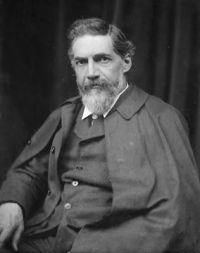 W. M. Flinders Petrie,
Methods & Aims in Archaeology
W. M. Flinders Petrie,
Methods & Aims in Archaeology
“ But to ensure the fullest knowledge, and the most complete preservation of things, in the long run, should be the real aim. To raid the whole of past ages, and put all that we think effective into museums, is only to ensure that such things will perish in course of time. A museum is only a temporary place. There is not one storehouse in the world that has lasted a couple of thousand years. Only two or three bronze statues have come down to us from classical times preserved by each generation. ”
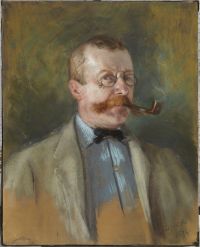 Laurence Hutton,
Portraits in Plaster, from the Collection of Laurence Hutton
Laurence Hutton,
Portraits in Plaster, from the Collection of Laurence Hutton
“ So far as I have been able to discover, mine is the most nearly complete and the largest collection of its kind in the world. I have, indeed, found nothing anywhere to compare with it. Usually, the Phrenological Museums contain casts of idiots, criminals, and monstrosities, and these are seemingly gathered together to illustrate what man’s cranial structure ought not to be. There are but three or four casts of xithe faces of distinguished persons in the British Museum, and about as many in the National Portrait Gallery in London ”
Samuel Butler, The Humour of Homer and Other Essays
“ By and by, when the whirligig of time has brought on another revenge, the museum itself becomes a dust-heap, and remains so till after long ages it is rediscovered, and valued as belonging to a neo-rubbish age—containing, perhaps, traces of a still older paleo-rubbish civilization. ”
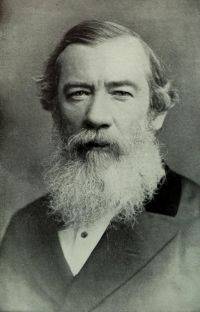 Moncure Daniel Conway,
Travels in South Kensington
Moncure Daniel Conway,
Travels in South Kensington
“ Never was more beauty wrought in iron than this by Huntington Shaw, of Nottingham, anno 1695. Under his hand rose, shamrock, and thistle have grown on the metal so tenderly that it would seem a breath might stir them, while from the Irish harp in the centre one might almost listen for Æolian strains. But that was done in a day when to work for a king was felt to be working for God. And all through this museum shines the great fact that the best work was never done merely for money, but for the altar, for love and loyalty. It is a Museum of Civilization, where each work is a heart. ”
Charlotte Fell Smith, Dictionary of National Biography… (1912)
“ The collection and the visitors increased rapidly, and in 1897 Horniman erected at a cost of 40,000l. a new and handsome edifice near at hand from the designs of C. Harrison Townsend, F.R.I.B.A., having on the exterior wall a mosaic panel, thirty-two feet by ten feet, designed by R. Anning Bell to represent the course of human life, and a memorial tablet by F. W. Pomeroy, A.R.A.; a bronze fountain by J. W. Rollins was given by Horniman's son. Finally in 1901 Horniman presented his museum and surrounding estate to the London county council. ”
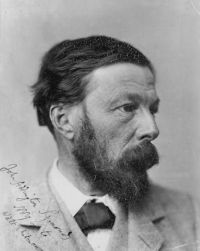 John Addington Symonds,
Sketches and Studies in Italy and Greece…
John Addington Symonds,
Sketches and Studies in Italy and Greece…
“ When we entered the Museo, we found a little old man, gentle, grave, and unobtrusive, varnishing the ugly portrait of some Signor of the cinquecento. Round the walls hung pictures, of mediocre value, in dingy frames; but all of them bore sounding titles. Titians, Lionardos, Guido Renis, and Luinis, looked down and waited for a purchaser. In truth this museum was a bric-à-brac shop of a sort that is common enough in Italy, where treasures of old lace, glass, armour, furniture, and tapestry, may still be met with. ”
Edward Harrison Barker, Wanderings by Southern Waters, Eastern Aquitaine
“ So much the better for the student of antiquities, for, without denying that museums are eminently useful, it is certain that they deprive objects of a great deal of their interest and their power of suggesting ideas by detaching them from their surroundings. Moreover, it is not at all sure that these things, when they have been bought up and carried away, will ever be put in a place where anybody can see them who may have the wish to do so. And then, when a thing has been put into a museum, it becomes such labour and painfulness to look for it; and most of us are so lazy by nature. ”
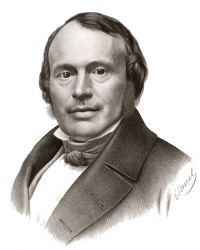 Louis Agassiz,
Louis Agassiz: His Life and Correspondence
Louis Agassiz,
Louis Agassiz: His Life and Correspondence
“ That frail structure, crowded from garret to cellar with seeming rubbish, with boxes, cases, barrels, casks still unpacked and piled one above the other, held for him the treasure out of which he would give form and substance to the dream of his boyhood and the maturer purpose of his manhood. The hope of creating a great museum intelligently related in all its parts, reflecting nature, and illustrating the history of the animal kingdom in the past and the present, had always tempted his imagination. ”
 Robert Hichens,
The Near East: Dalmatia, Greece and Constantinople
Robert Hichens,
The Near East: Dalmatia, Greece and Constantinople
“ It is no longer mysterious. A successful man is making a fortune out of soap there. But it is a place one cannot easily forget. And just above the ruins there is a small museum which contains several very interesting things, and one thing that is superb.This last is the enormous and noble upper part of the statue of a woman wearing ear-rings. I do not know its history, though some one assured me that it was a caryatid. It was dug up among the ruins, and the color of it is akin to that of the earth. The roughly undulating hair is parted in the middle of a majestic, goddess-like head. ”
Ada Alice Cunnick Inchbold, Lisbon and Cintra (1907)
“ As numerous additions have since been made to the collection, and the compilers of the book even then pleaded lack of space in convenient disposition of exhibits, the value and interest of the museum are lessened by deficient arrangement. In the roofless naves relics from many ruined ecclesiastical buildings have found a refuge. Many of them merit as specimens of ancient sculpture and decoration to be under cover for their surer preservation from injury. ”
John Ruskin,
Arrows of the Chace, vol. 1/2
“ After men have learnt their science or their art, at least so far as to know a common and a rare example in either, a national museum is useful, and ought to be easily accessible to them; but until then, unique or selected specimens in natural history are without interest to them, and the best art is as useless as a blank wall. For all those who can use the existing national collection to any purpose, the Catalogue as it now stands is amply sufficient: it would be difficult to conceive a more serviceable one. ”
Related terms
Authors who wrote about “Hunterian Museum”
Margaret Talbot JacksonArthur E. P. Brome WeigallGeorge Thomas BettanyEdward EdwardsLouis Agassizeditor W.L. DistantBlanchard JerroldD'Arcy PowerJohn RuskinBritish MuseumVarious Lewis MumfordW. M. Flinders PetrieMuseum of History and TechnologyG. T. BettanyCharles Dudley WarnerArthur Thomas MalkinSamuel ButlerSamuel Smiles
 Rudyard Kipling
George Thomas BettanyEdward EdwardsLouis Agassizeditor W.L. DistantBlanchard JerroldD'Arcy PowerJohn RuskinBritish MuseumVariousLewis MumfordW. M. Flinders PetrieMuseum of History and TechnologyG. T. BettanyCharles Dudley WarnerArthur Thomas MalkinSamuel ButlerSamuel SmilesRudyard Kipling